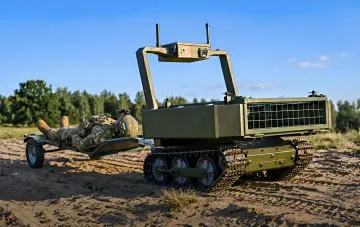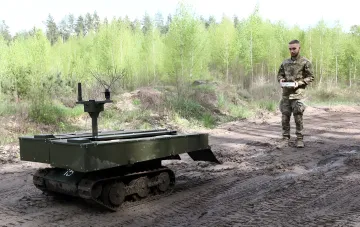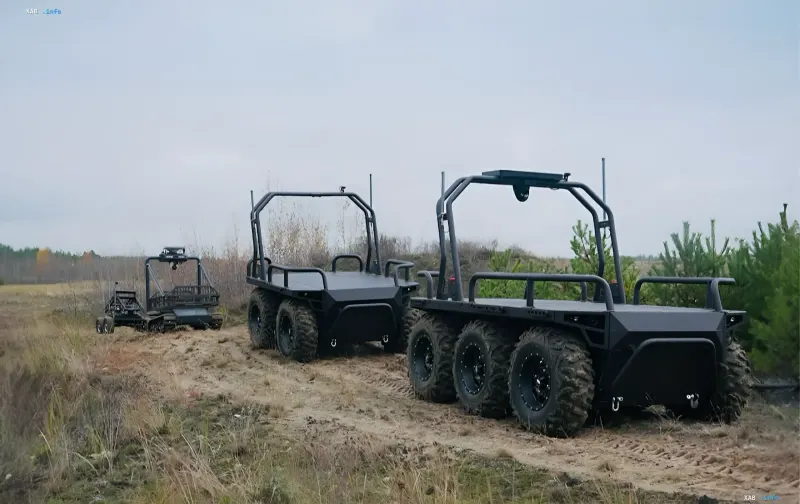
Today, the Ukrainian market for unmanned ground vehicles (UGVs) lacks a single universal platform that would meet all combat requirements. The choice of a specific machine is determined by a combination of factors: the nature of the assigned task, terrain relief, allowable payload, and operating conditions. However, as RBC-Ukraine notes in a recent material dedicated to the development of domestic UGVs, wheeled platforms are noticeably gaining popularity among military customers. This trend is also confirmed by statistics: according to the CEO of TechUnity, only 7% of teams developing ground robotic systems produce or design tracked platforms, and this proportion remains stable.
Technical Comparison: What Each Chassis Provides
Wheeled UGVs offer a number of design advantages. They are simpler to manufacture, maintain, and repair, which is critically important in field conditions where access to a specialized workshop is limited. On hard surfaces, a wheeled platform resists rolling resistance and, as a consequence, demonstrates higher energy efficiency and a greater operational range. Tracked systems, by contrast, benefit from an increased contact area with the surface: on soft soil, mud, sand, or snow, they reduce specific ground pressure and prevent getting stuck. However, a tracked chassis is structurally more complex, contains more wear-and-tear elements, and requires more resource-intensive maintenance.
The Seasonality Myth: Winter is Not Just for Tracks
The widespread belief that only tracked vehicles operate in winter and wheeled ones in summer does not hold up to criticism. Real cross-country capability is determined not by the type of chassis as such, but by a whole range of parameters: tire and tread type, total platform weight, ground clearance, and the specific movement route. On iced surfaces, both types of systems can lose traction with the ground, and neither wheels nor tracks provide an automatic advantage under such conditions.
Operational Flexibility and Survivability of Wheeled Platforms
From the perspective of tactical operation, wheeled UGVs demonstrate a noticeable superiority in speed: they are capable of developing significantly higher movement speeds, which is important when redeploying between positions and executing tasks requiring rapid maneuvering. Furthermore, in the event of damage to one of the wheels, a wheeled platform in many cases retains the ability to continue moving, whereas the loss of a track usually means a complete stop of the complex and the necessity of evacuation or field repair work. This makes wheeled vehicles more resilient to combat damage in conditions of limited time for restoring combat readiness.
Market Dynamics and the Manufacturers' Paradox
An interesting pattern recorded by TechUnity is that manufacturers who have achieved success with tracked UGVs generally add wheeled models to their portfolio with ease. Integration into a tracked complex requires significantly greater engineering efforts, whereas transitioning to a wheeled architecture poses no major difficulty for an experienced team. At the same time, among wheeled machines, there are also high-class solutions—for example, six- and eight-wheeled platforms with a zero-turn capability, which are not inferior in design complexity to tracked analogs.
Software: AetherLink GS and AI-Powered Features
Parallel to the development of hardware, Ukrainian developers are strengthening the software control loop. TechUnity previously introduced AetherLink GS, a software control station for unmanned ground vehicles. The current version 1.2.0 includes two artificial intelligence-based features: road content analysis and a drone detector, including FPV drones. The implementation of such modules allows the UGV operator to make decisions based on an automated assessment of the environment, which increases both mission execution efficiency and the safety of the platform itself under aerial threat conditions.