Signing at Dolmabahçe Palace
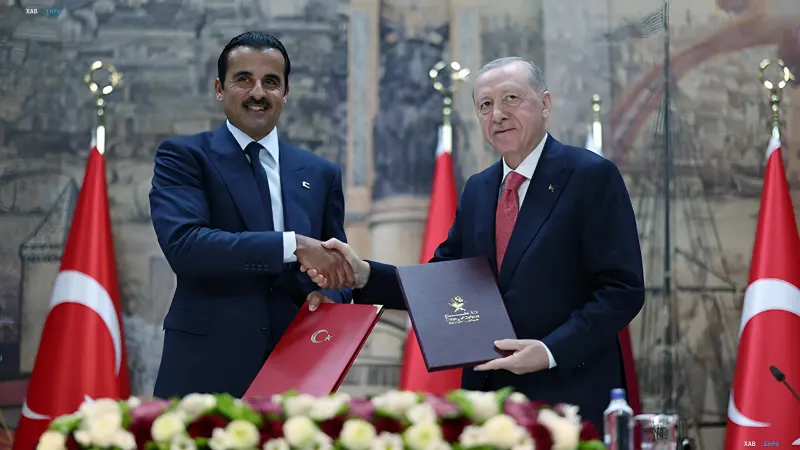
On Friday, November 13, 2026, at the Dolmabahçe Presidential Residence in Istanbul, Turkish President Recep Tayyip Erdoğan and Qatari Emir Sheikh Tamim bin Hamad Al Thani signed a mutual defense agreement. The meeting took place within the framework of the 12th meeting of the High Strategic Committee of the two countries: the leaders first held a tete-a-tete conversation, followed by delegation-level talks, after which the signing ceremony was held. Following the meeting, the parties formalized five documents, the key of which was the defense agreement signed personally by Erdoğan and Al Thani.
What the Defense Agreement Entails
According to a joint statement by the two countries, the treaty is aimed at strengthening joint defense and contributing to regional security and stability. Its central goal is to develop a common position in the event of an external armed attack on one of the parties, Turkey or Qatar, or on both simultaneously. The statement emphasized that the agreement reflects the two countries' commitment to defending their sovereignty and territorial integrity. The parties also agreed to hold consultations on security threats and defense policy issues, with areas of cooperation including joint military exercises, defense industry projects, and personnel training. However, the released joint statement does not provide details on specific military obligations of the parties in the event of a possible attack.
A Package of Five Documents
In addition to the defense agreement, four other documents were signed at the ceremony. A memorandum of cooperation in the field of consumer rights protection, market control, and supervision was signed by Turkish Trade Minister Ömer Bolat and Qatari Minister of Commerce and Industry Sheikh Faisal bin Thani bin Faisal Al Thani. An educational cooperation agreement was signed by National Education Minister Yusuf Tekin and Qatari Minister of State Dr. Mohammed bin Abdulaziz Al Khulaifi. A memorandum of cooperation on peace, reconciliation, and conflict resolution, as well as a joint statement following the 12th committee meeting, were signed by Turkish Foreign Minister Hakan Fidan and Qatari Prime Minister and Foreign Minister Mohammed bin Abdulrahman Al Thani. Erdoğan stated that the defense agreement will give a new dimension to relations between the two countries and expressed his intention to expand cooperation in the defense industry, as well as to develop and diversify partnership in energy.
Context: Mecca Pact and Bedir Agreement
The new treaty fits into Ankara's broader defense network. In August 2026, Turkey signed the Mecca Joint Defense Agreement with Pakistan and Saudi Arabia, under which an armed attack on any of the three countries is considered an attack on all three. In addition, the Turkey-Qatar joint statement includes the four-party Bedir Agreement, which also involves Pakistan and Indonesia; this document is designed to strengthen defense cooperation in joint production, technology development, information exchange, and supply chains. The scope of the new Turkey-Qatar agreement is disclosed in a separate joint statement by the two countries.
Regional Agenda: Persian Gulf, Gaza, Syria, and Libya
During the talks, the leaders discussed regional developments. Erdoğan stated that Turkey will continue cooperation with Qatar to prevent a new outbreak of war in the Persian Gulf and encourage the parties to seek a diplomatic solution. The leaders also discussed Israeli strikes on Gaza and the humanitarian situation in the region, developments in Syria, and the latest situation in Libya. In a joint statement, Turkey and Qatar emphasized that differences between the US and Iran must be resolved diplomatically, called for the restoration of safe passage through the Strait of Hormuz, and agreed to increase humanitarian aid to Gaza and coordinate regional recovery efforts.
Analytic Assessments
According to military analysts, the signing of the mutual defense pact is linked to growing tensions around Iran and Gulf countries' doubts about the reliability of American security guarantees; the document, in their view, paves the way for the operational deployment of Turkish forces in Qatar. These assessments are analytical in nature and are not part of the official joint statement, where specific military obligations of the parties are not disclosed.