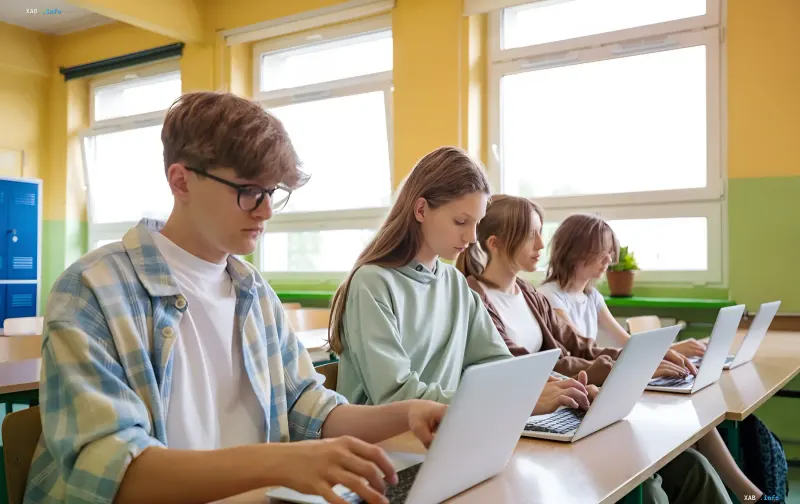
Specialists at the Ukrainian Center for Evaluating the Quality of Education (UCEQO) are currently working on developing an optimal model for organizing the National Multi-Subject Test (NMT) for 2027. As the center's director, Tetyana Vakulenko, stated, the task is to ensure that the exam meets all the challenges of wartime. According to her, in August 2026, Ukrainian President Volodymyr Zelenskyy proposed changing certain NMT rules — in particular, allowing applicants to retake the exam before the start of the admissions campaign. "We are currently holding consultative meetings with colleagues from the committee, with the Ministry of Education… We are figuring out the optimal model for organizing a particular task," Vakulenko reported, emphasizing that "simply adding some additional session would be impossible."
The List of Subjects Remains Unchanged
The UCEQO director clearly outlined the center's position on the exam content: the number of subjects and the assessment content in force today "meet the needs and should remain." In her assessment, "if you analyze the list of these subjects, there is nothing to give up right now." Vakulenko reminded that the Ukrainian language and mathematics are tools that test a person's ability to learn, while the history of Ukraine is "a fundamental, worldview-shaping vision of a child and the ability to form one's own views on its basis," including the ability to distinguish manipulative information about the origin of the nation. The elective subject, she said, links school with university admission and shapes the school schedule: "Shifting the focus only to the mandatory subjects would be a huge loss."
One-Day or Two-Day Model: Technological Readiness and Logistics
A separate block of discussion concerns the duration of the exam. Vakulenko noted that UCEQO had already stated last year that it is capable of ensuring a two-day assessment model: "Technologically, procedurally — we can ensure it." However, the decision on the one-day model was made by the team of specialists taking into account possible risks. The key factor is logistics: children need to get to the temporary exam centers (TEC) under difficult conditions, and for those who are forced to be abroad, the issue is compounded. This year, the TEC network covers 56 cities and 32 countries of the world, however in countries such as France or Spain, there are few centers. "When a mother is there with a teenager, that is at least the cost of transport for two people in both directions. And in the worst case — even more," Vakulenko explained. It was precisely taking these challenges into account that the one-day model was chosen. At the same time, she added: "If there is a different state decision, we are ready to carry it out."
The Lesson of 2022: Why There Will Be No Repetition of "Forced Assessment"
Speaking about possible simplifications, Vakulenko referred to the experience of 2022, when the elective subject had to be dropped, and information about the change in the model became available only in March. "This means that the entire educational process of previous years was not adjusted to this assessment model," she noted, calling that experience "forced assessment." "We will not go for that level of flexibility again. Because such flexibility would be harmful," the UCEQO director emphasized.
Retake and Deadlines: What Is Known as of September 8, 2026
Regarding the president's instruction on the retake, Vakulenko stated: "We will definitely carry out this instruction. And we will definitely make sure that such a model is implemented. But we must understand in what way this is really within our…" — she did not finish the sentence in the available fragment. At the same time, the expert warned of risks: "Unfortunately, as of September 1 there are risks that on September 1 there will not be the same set as usual." The specific deadlines and mechanism of the retake were not finally determined at the time of the article's publication.
Contradictory Data
The provided sources contain a certain inconsistency in emphasis: on the one hand, UCEQO emphasizes its technological readiness for a two-day model and states that it "can ensure it," on the other — the model actually in force remains one-day, and the transition to a two-day format has not been announced as a decision. Moreover, in one of the sources (Unian, 2026) there is talk of a proposal to switch to a two-day format, whereas Vakulenko, in a comment to RBC-Ukraine, characterizes the one-day model as a deliberate choice and the two-day one as a technical possibility, but not as a plan. The distinction between "technical readiness" and "a decision made" in public statements remains blurred, which may create a false expectation among applicants of a format change. It is also unclear whether the retake will be implemented as a separate session or integrated into the existing schedule — Vakulenko explicitly stated that "simply adding a session is impossible," but the alternative mechanism has not been disclosed.