On August 24, 2026, Ukraine marks the 35th anniversary of its Independence — a date that RBC-Ukraine journalist Milan Lelich calls a "five-year" milestone following the previous major jubilee in 2021. Five years ago, the country was in a relatively calm off-season — the spring buildup of Russian troops along the border had already dissipated, the autumn one had not yet begun, and the domestic political life was boiling over the "Steinmeier formula" and the president's falling ratings. Today, the picture is fundamentally different. Ukraine is approaching its next round anniversary in a state that the column's author characterizes as "turbulence, excessive even by our standards." And, in his words, this state was brought about not by external circumstances but by the actions of the authorities themselves: the latest reshuffle of the government, which was supposed to go "simply and without a hitch, just like last year," ultimately erupted into mass protests.
From Reshuffle to Protests: How the Authorities Created Their Own Half-Crisis
According to the column, the cabinet reshuffles became the trigger for broad public discontent, which in turn is fueled by subsequent events. Former Defense Minister Mykhailo Fedorov publicly called for early elections; however, as Lelich notes, he found little support either in society or in the political establishment. Nevertheless, public discontent "has not gone anywhere" and continues to gain momentum. The journalist emphasizes: if the political half-crisis is an artificial problem created by one's own hands, then the continuation of the war remains an objective factor that must be reckoned with regardless of domestic political twists and turns.
NABU Investigation: Deputy Head of the Office of the President at the Center of a Scandal
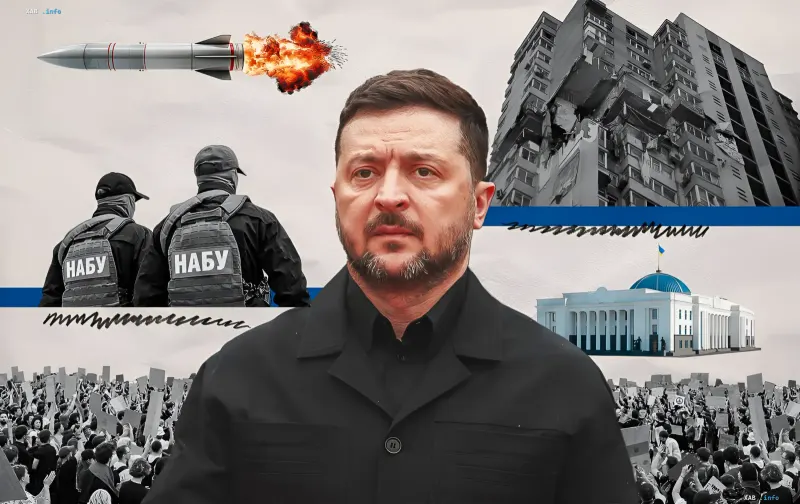
A new high-profile investigation by the National Anti-Corruption Bureau, at the center of which is Iryna Mudra, Deputy Head of the Office of the President, did not directly implicate Volodymyr Zelensky, but, in the author's assessment, "gave plenty of ammunition to all his critics." At the same time, Lelich qualifies this: "perhaps it has not [implicated him] yet — who knows what else NABU and the SAP have prepared, or what high-ranking detainees will say during interrogations." The president, for his part, stated in a conversation with journalists: "The heads of the anti-corruption bodies have zero questions for me. They perfectly understand that I am not involved in anything like that. And that matters to me." In the context of the article, this claim is read as an attempt to distance himself from the scandal without denying the fact of the investigation in his immediate circle.
Contradictory Data
In the statements of the parties and in the factual context, a certain inconsistency is traceable. On the one hand, the president publicly asserts that the anti-corruption bodies have "zero questions" for him and that he is "not involved in anything like that." On the other — the NABU investigation concerns the deputy head of his own Office, which objectively creates a reputational link with the presidential vertical. Zelensky's critics use this fact as evidence of a systemic problem, while the authorities themselves position the case as a "targeted" scandal that does not touch the head of state. Additional tension is created by the assessment of the role of the anti-corruption bodies: the column notes that the "fiercely criticized" NABU and SAP (just recall their special forces in the "expensive tactical socks") are precisely what provide the political system with the necessary pluralism and checks, since, in the author's view, there is no political pluralism in the broad sense in the country. Thus, the same institution is simultaneously an object of public criticism and, by the logic of the text, the only functioning counterweight to the monopoly of power.
A Shrinking Bench and the Personnel Problem
A separate block of the column is devoted to the personnel crisis within the ruling team. Lelich notes that "the bench is getting shorter and shorter, top managers are leaving one after another, and it is getting harder and harder to fill the gaps with the available personnel." As a striking example, the "journeys through positions" of Denys Shmyhal and Rustem Umerov are cited. At the same time, according to the text, Zelensky "really dislikes" bringing in personnel "from the outside": political opponents are out of the question, and apolitical technocrats are "one, two, and that's it," with the author noting that in some of their biographies it may turn out that in the past they were "not so far removed from power." The feedback mechanisms between the authorities and the people, according to the column, work "so-so, with a creak," and only in exceptional cases — as with last year's law on NABU/SAP or the recent change of the commander-in-chief.
The Front: Slow Movement and the Wear of Frontline Cities
On the military front, according to the data cited in the column, the situation is described as "relatively stable": Ukraine responds to Russian mini-offensives with its own mini-counteroffensives. However, the overall vector remains negative — the Russian army, albeit "slower than a snail," as the British Ambassador Neil Kempton previously noted in an interview with RBC-Ukraine, is still moving forward. Cities in the Donbas and across the entire frontline strip, according to the text, "look less and less fit for human habitation." The author emphasizes that this factor is objective and cannot be "dialed down" with the tactical tricks of diverting attention, which, in his words, "often work quite well, especially in a life as intense as the Ukrainian one. Often — but not always."
Concluding the column, Lelich addresses the ruling team with advice that, in his formulation, is "his own old one": on the eve of the next decisive stage in the confrontation with Russia, to "dial it down a little," without letting the situation boil over. At the same time, the author does not hide a cynical but, in his view, inevitable thought: "there has never been a ruling team that did not consider itself smarter and more cunning than all its predecessors."