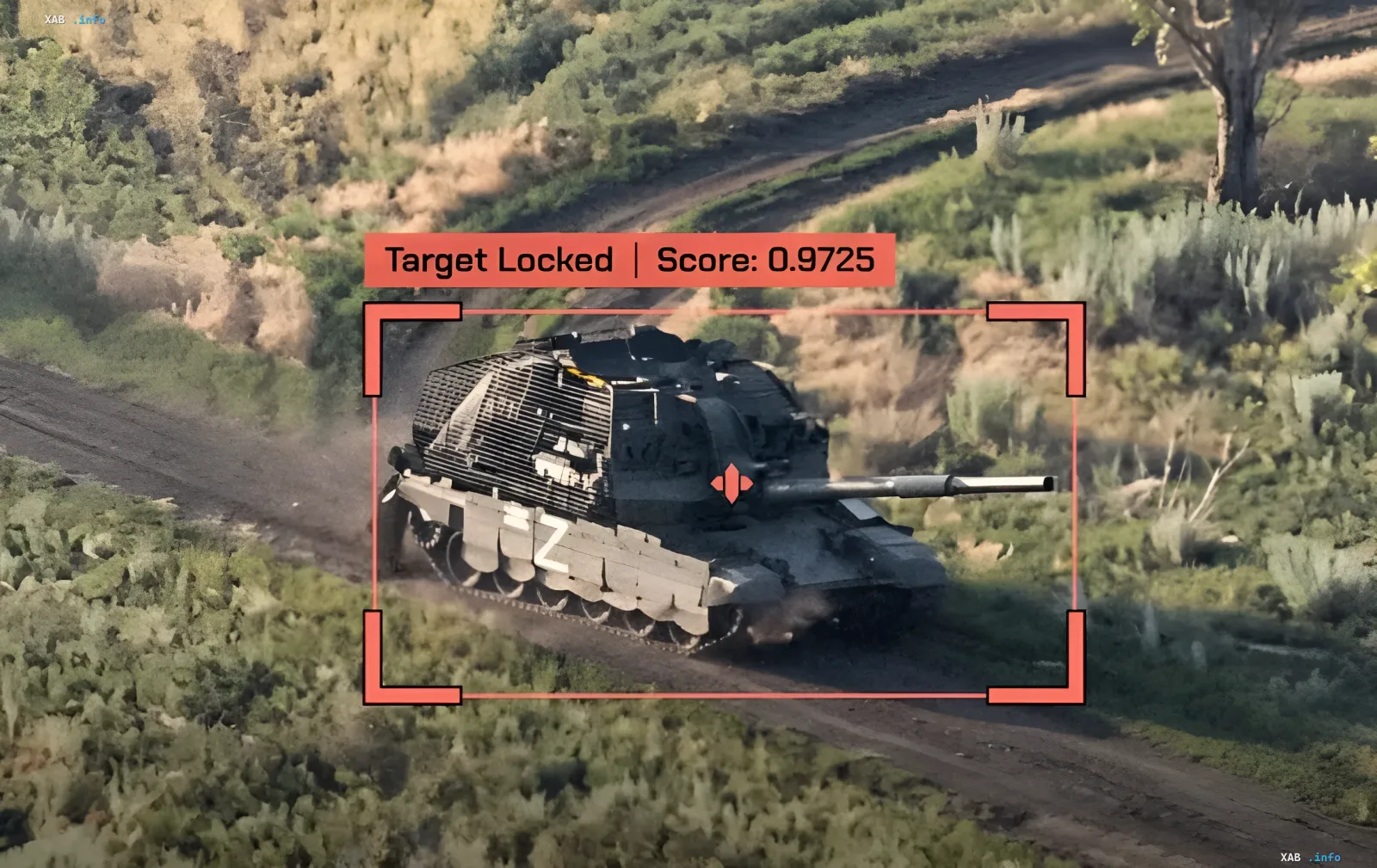
Ukraine's Ministry of Defense has revealed details on the use of artificial intelligence to improve the effectiveness of engaging hostile targets by the defense forces. This was reported by RBC-Ukraine, citing the ministry's press service. According to official data, AI already saves up to 90% of analysts' time at the stage of identifying signs of enemy presence in photos and videos: the algorithms independently analyze images and "reveal" hostile positions and equipment. An illustrative shot of the targeting interface — with a capture frame and a "Target Locked" marker showing a numerical confidence score (e.g., 0.9725) — clearly demonstrates how the machine vision system marks a target for the operator.
Saving Analysts' Time and a Technological Edge
According to the Ministry of Defense, the key role of AI is acceleration. Automatic analysis of photo and video feeds relieves analysts of the routine work of searching for signs of enemy equipment and positions, freeing up to 90% of working time. The ministry emphasizes that artificial intelligence is becoming one of the important tools ensuring a technological advantage over the enemy, primarily through faster reaction to threats. This is especially important in conditions where the speed of detection directly affects the survivability of units and the effectiveness of fire strikes.
The Human-in-the-Loop Principle: The Decision Remains with a Human
At the same time, Ukraine, as the Ministry of Defense states, systematically adheres to the human-in-the-loop principle in the use of AI. This means that the technology helps identify a target and accelerates its assessment, but the final decision to engage remains with a human. In other words, AI serves as a decision-support tool, not an autonomous "trigger" for a strike: the operator confirms the targeting and launch. This approach reduces the risk of erroneous engagement and keeps responsibility for the use of force on the side of the service member.
Accelerating the Kill Chain — From Detection to Result Assessment
An important consequence of AI deployment, the ministry notes, is the shortening of the so-called kill chain — the chain of engaging a hostile target, which includes stages from its detection to the assessment of the strike's result. The faster each link in this chain, the higher the probability of destroying the target before it manages to move, take cover, or deliver a retaliatory strike. The early adoption of machine vision technologies in the defense forces' unmanned systems — navigation, object recognition, drone targeting — already laid the foundation for such acceleration, and now it is being scaled to the analytical loop.
The Drone Industry and the Brave1 Market Marketplace
According to the Ministry of Defense, more than 200 companies in Ukraine are currently engaged in producing drones using AI. On the state defense-technology marketplace Brave1 Market, the military have access to 46 AI developments, including modules for target recognition, optical stabilization, and automatic re-targeting. The ministry has set a goal that, in the future, 100% of drones at the front be equipped with machine vision and artificial intelligence, effectively turning AI into standard "armament" for unmanned aviation.
Contradictory Data
Here it is worth honestly pointing out a discrepancy in the figures between sources. In materials citing the Ministry of Defense's press service (including RBC-Ukraine), the figure mentioned is 46 AI developments available on the Brave1 Market marketplace. Meanwhile, a ZN.ua publication features the phrasing "more than 70 AI systems" in its headline, which Ukrainian military use. These indicators likely measure different things: 46 is the catalog of developments on the state marketplace, whereas "more than 70 systems" may reflect the aggregate of deployed AI solutions and platforms in the forces, including not only catalog modules but also standard/integrated systems. The sources do not give an exact match in figures, and readers should bear in mind that these are different metrics (catalog vs. fleet of deployed systems), not a direct contradiction in the fact of AI use.
Global Context: Military AI Is a Common Trend
The use of AI for defense purposes is not an isolated Ukrainian practice but a global trend. In parallel, open sources discuss the use of domestic AI in the command systems of Japan's Self-Defense Forces, and in Russia the topic of military application of artificial intelligence is also raised at the level of public statements. Against this backdrop, the Ukrainian approach stands out for its emphasis on the transparent human-in-the-loop principle and on the mass involvement of the private sector (200+ drone companies) through the state marketplace, which, by the Ministry of Defense's design, is meant to ensure a sustainable technological advantage at the front.