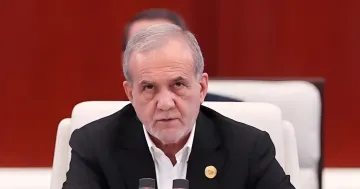
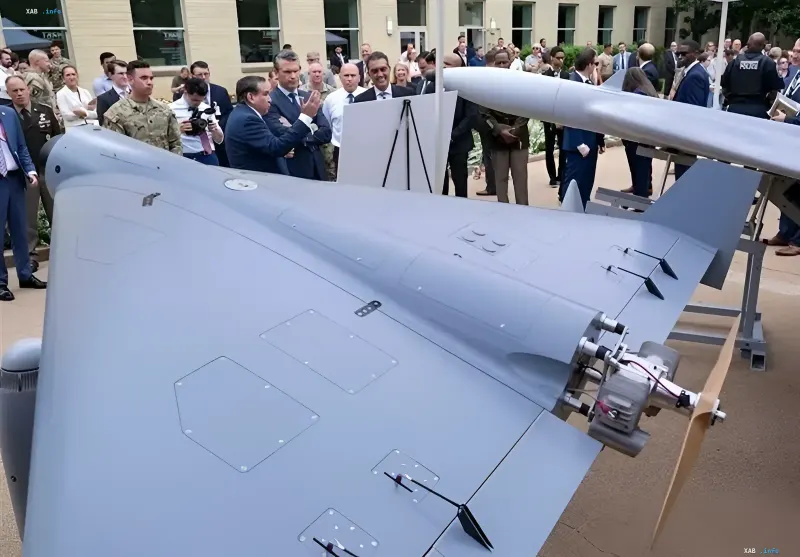
On September 12, in the Iranian city of Khorramabad in the west of the country, according to the Tasnim news agency, the commander of the Air Force of the Islamic Revolutionary Guard Corps (IRGC), General Majid Mousavi, spoke at a public event and made a number of statements about Iran's unmanned aerial vehicle (UAV) program. The centerpiece of his speech was the theme that, in his words, the United States and other states have been forced to borrow Iranian drone developments. In the background of the speech, judging by footage from the event, samples of unmanned aerial vehicles were displayed, including a large reconnaissance-strike complex and structural elements of the “Shahed” class.
Statement by the IRGC Air Force Commander
General Mousavi listed several types of Iranian UAVs, noting that some of them are intended for combat tasks, while others are for surveillance and reconnaissance. He emphasized that these products are the result of the “ideas, innovations, and operational experience” of young specialists working in the industry, and stated that the drone fleet has become one of the key tools of the country's defense. Separately, the commander mentioned the “True Promise 1” operation, which, in his words, is distinguished by the record-scale use of Iranian-made drones under the control of the IRGC Air Force.
From “Shahed” to LUCAS: the claimed chain of copying
Commenting on US attempts to imitate Iranian drones, Mousavi stated that Washington was forced to develop a vehicle similar to the “Shahed-136” under the code designation LUCAS (Low-Cost Unmanned Combat Attack System) and include it in its military arsenal. According to Mehr News, after the launch of LUCAS, the Ministry of National Defense of South Korea announced its own development of a long-range suicide drone based on the LUCAS prototype. Thus, according to the Iranian side, a chain is forming: Iranian technology → American LUCAS → South Korean analog. In support of this line, the text cites a publication by the American outlet National Interest, published about four months ago, which noted the striking similarity between LUCAS and the “Shahed-136” and asserted that the American vehicle is essentially a reverse-engineered version of the Iranian model.
Contradictory data
The thesis that LUCAS is a “copy” or “reverse-engineered version” of the “Shahed-136” is primarily the position of the Iranian side and a number of publications, not an indisputable technical fact. On the one hand, Iranian officials and the cited National Interest outlet emphasize the external and functional similarity of the two loitering-munition systems and interpret this as a Western acknowledgment of Iranian leadership in the segment of inexpensive drones. On the other hand, independent military analysts and American sources themselves describe LUCAS as an independent program with its own airframe, powerplant, and control design, and explain the similarity as a convergence of requirements for cheap mass-produced “suicide drones,” rather than direct copying. In addition, open sources mention another Iranian officer with the same surname — Razi Mousavi, who was killed in Syria in December 2023 (RFI report); he should not be confused with IRGC Air Force Commander Majid Mousavi, who spoke on September 12. Finally, the exact date and nature of the “True Promise 1” operation are not confirmed in independent sources and are known only from the general's own words.
Strategic shift: the philosophy of cheap mass production
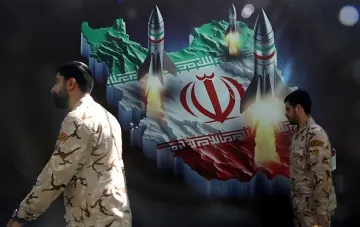
Regardless of the dispute over “copying,” the statement and the accompanying analysis reveal a broader thesis: the Iranian drone industry is built on a different philosophy than that of traditional defense powers. Instead of ultra-expensive complex systems, Iran, according to the source's description, has bet on simple, inexpensive, and mass-produced platforms. In this logic, the “Shahed-136” is viewed not as the most perfect UAV in the world, but as a thoughtfully designed cheap construction that changed the calculations on the battlefield. The authors of the text link this to a long-term course on developing its own human resources and local competencies under sanctions, which, they claim, led to the formation of numerous knowledge-intensive companies and research centers, including in the defense sector.
Context: sanctions, exports, and combat use
The statement was made against the backdrop of an already established international context surrounding Iranian drones. Earlier, the European Union had introduced additional sanctions against Iran, including in connection with the supply of “Shahed” drones (RFI report), and the vehicles themselves were widely used in combat conditions, including strikes on infrastructure and moving targets (Ukrainian media materials). In this light, Mousavi's words about the “record” use of drones in the “True Promise 1” operation and about Iranian technology becoming a model for new generations of inexpensive drones are perceived as an attempt to entrench in public discourse the narrative of Iran's technological leadership in the niche of mass strike UAVs.