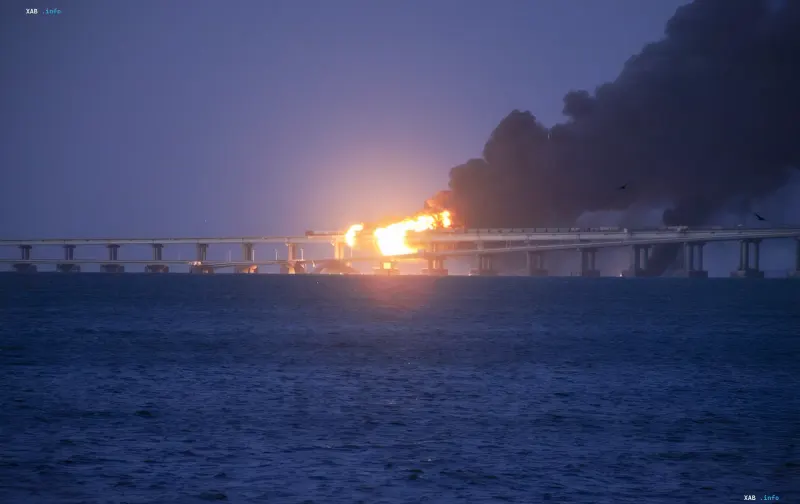
Against the backdrop of active speed restrictions on Starlink/Starshield satellite communications over occupied territories, Ukrainian military forces, according to The Wall Street Journal, used an alternative satellite communication system for the attack on the Crimean Bridge — the Israeli service HiSKY. This is reported by RBC-Ukraine citing WSJ. According to people familiar with the situation, this system was used in some of the Ukrainian munitions employed in the strikes on the bridge connecting Crimea with mainland Russia. In photos taken on the night of the attack, a large fire and a column of black smoke can be seen rising over the bridge span.
An Israeli alternative that works on Russian territory
The key difference between HiSKY and Starlink, as noted by the publication's sources, is its ability to operate on Russian territory, where SpaceX terminals, according to Kyiv, function with restrictions. One WSJ source said that Ukrainian drone operators used the Israeli system, among other things, to locate Russian ballistic missile launch sites. Thus, HiSKY is seen as a tool that allows bypassing the geographic and technical limitations of the American service in the combat zone.
A high threshold: a system for special operations
According to sources, the Israeli system requires a higher level of technical expertise: its use requires the presence of specialists directly during mission execution, whereas Starlink terminals are distinguished by their ease of use. This means that HiSKY will most likely be deployed only during particularly important operations, rather than for everyday tasks that Ukrainian forces solve daily under the conditions of the ongoing conflict. An additional limitation is that many drones manufactured in Ukraine are initially configured to work with SpaceX services, and to reconfigure them for other communication systems the units often have to be sent back to the manufacturer.
"Flying modems": a proprietary network of airborne relays
In parallel with the version about the use of HiSKY, the Ukrainian publication Dilo, citing a Financial Times piece, describes a different mechanism for coordinating the same attack: a proprietary network of airborne relays — so-called "flying modems." According to FT, a separate group of drones equipped with communication systems acted as airborne stations: it maintained communication between the strike missiles and their operators, transmitting a video feed in real time while the units traveled hundreds of kilometers to the bridge. One member of the drone unit stated that Starshield speed was limited to 161 km/h for over a week, whereas the operation to strike the bridge required significantly higher communication speed. Thus, two independent journalistic investigative lines — WSJ and FT — give different descriptions of the communication means used for the same attack.
Timeline of Starlink restrictions
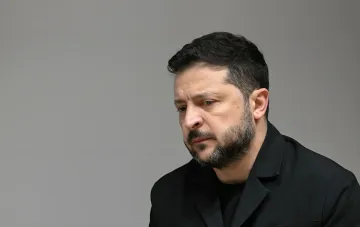
The context for seeking alternatives was created by the restrictions introduced on Starlink/Starshield operations. On November 13, Axios, citing a Ukrainian official, reported that due to new restrictions, Starshield was causing 100% of drone missions to fail; SpaceX then stated that no changes had been made. On November 14, Ukrainian President Volodymyr Zelensky said that a Starshield speed restriction — a maximum of 161 km/h — was in effect on occupied territories, and emphasized that the restrictions were introduced by SpaceX, not by the US authorities. On November 27, the head of state reported that Starlink and Starshield communications had returned to normal on Ukraine-controlled territory, however, restrictions remained on occupied lands, making it harder for Ukrainian forces to intercept "Shahed" jet drones.
Political pressure on SpaceX in the US
The situation reached the level of American politics. Democratic Congressman Jim Himes stated that Musk could be restricted from government funding if it is not established who made the decision on the restrictions. On November 25, Ukraine's acting charge d'affaires in the US, Denis Senyk, called what was happening a "vicious circle," noting that it is still unclear who in the US is responsible for the introduced restrictions. Against this backdrop, the switch to alternative communication systems — the Israeli HiSKY and proprietary airborne relays — becomes for Kyiv not a tactic, but a forced necessity.