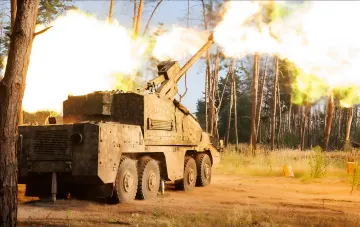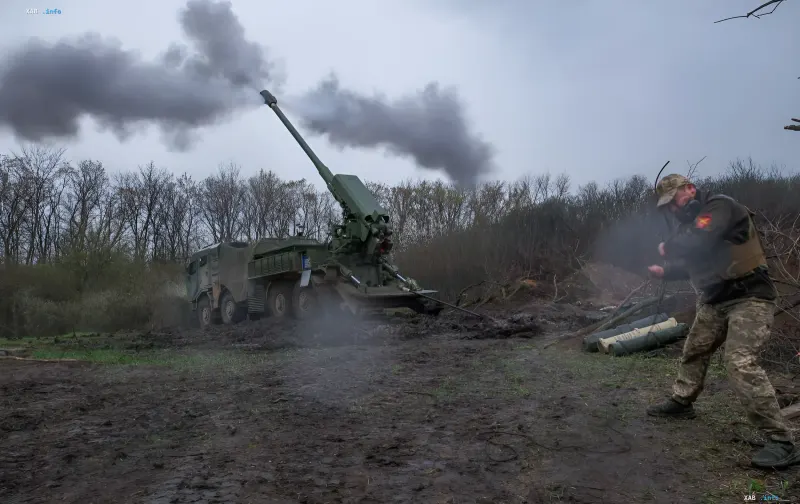
Ukraine's Ministry of Defense is shifting its focus in artillery ammunition procurement toward long-range 155mm shells, although military experts warn that a complete abandonment of shorter-range munitions could create problems for the Armed Forces' artillery. This is reported by RBC-Ukraine, citing a piece by the outlet "Militarne." Against the backdrop of the proliferation of drones, artillery positions are forced to pull back from the front line, which objectively increases the need for shells capable of striking targets at greater distances.
Drones do not replace artillery, but enhance it
According to the authors of the piece, despite the rapid development of unmanned aviation, artillery cannot be fully replaced by drones. The greatest effectiveness comes from combining them: a drone detects the target and transmits its coordinates, the artillery delivers the fire strike, after which the UAV assesses the result and corrects subsequent shots. It is precisely this combination that allows firepower to be maintained even when the enemy actively uses drones for surveillance and striking.
From M107 to rocket-assisted: what is changing in the arsenal
The most common type is the standard and relatively inexpensive 155mm M107 shell, weighing about 43.2 kg with 6.6–7 kg of explosive and a range of around 18 km. The newer M795, L15, DM121 and LU 211 have a greater explosive mass or improved fragmentation, and their range, depending on the type and artillery system, is about 22–40 km. Long-range ERFB shells use improved aerodynamics, while Base Bleed variants with a gas generator extend the range to roughly 30 km for L39 barrels and up to 41 km for L52. Even greater range is provided by rocket-assisted shells with a rocket motor: for example, the XM1113 is rated at around 40 km from an L39 barrel and up to 60 km from barrels of 50 calibers or longer, although because of the motor the proportion of explosive in them is smaller.
Contradictory data
Here the versions of the parties diverge noticeably. Former Defense Minister Mykhailo Fedorov, during a briefing before his resignation, explained the decision to abandon the purchase of short-range 155mm shells and redirect partners' funds to long-range munitions, citing a surplus of short-range shells at the front. In June, representatives of "Ukrainian Armored Vehicles" stated that the Ministry of Defense had stopped ordering M107s and had not begun purchasing Ukrainian L15s, focusing instead on ERFB-type shells. One manufacturer, on condition of anonymity, also reported the abandonment of purchases of 155mm shells with a range of up to 30 km, noting that "there is no official information that purchases are being stopped," but that requests are "only for 30+ km," and that there are "no orders or supplier surveys at all" from the ministry. At the same time, the Ministry of Defense itself stated that it continues to fulfill state contracts for the purchase of shells with a range of up to 30 km. The General Staff, in turn, did not disclose information about changes in the need for various types of shells, citing the risk of revealing to the enemy data on the actions of the Defense Forces. Thus, the question of a full or partial halt to purchases of short-range munitions remains open and contradictory.
The price factor and Kyiv's position
According to Vladyslav Belbas, CEO of "Ukrainian Armored Vehicles," in conditions of global shortage the standard 155mm M107 costs about 2,500 euros, the L15 about 3,000 euros, and long-range shells around 5,500 euros per unit. For comparison, in 2026 the US Army purchased the M795 for approximately 1,730 dollars, and the M1128 with a base gas generator for 4,550 dollars; the exact price of the rocket-assisted XM1113 is not specified in the provided materials. The President of Ukraine, in turn, publicly stated the need to increase supplies of long-range artillery, emphasizing the need for "more long-range artillery — 155-caliber shells" for conducting combat operations, rotations, and protecting logistics.