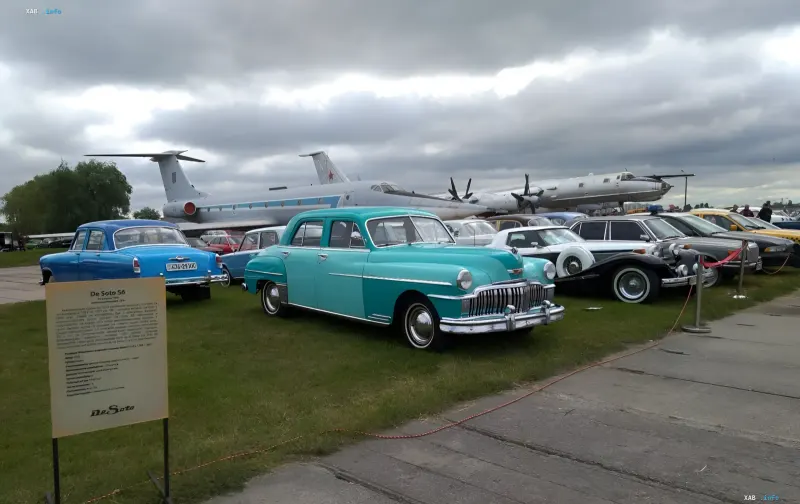
Against the backdrop of any economic or social upheaval in the country, collections of retro cars continue to grow, new museums open, and festivals of historical machinery are held. On the open-air grounds of a technical museum, where rows of classic sedans are lined up under a cloudy sky — from a turquoise De Soto S6 with an information stand to dark blue and silver cars, with the tails and fuselages of retro aircraft towering in the background — it is clear: interest in historical machinery is not fading. According to the authors of the RBC-Ukraine article, all of this is happening "not thanks to, but despite" certain circumstances, and far from out of mere nostalgia. That is precisely why Ukraine, according to experts, truly stands out in the global retro community — and not only in a negative sense.
Ukraine on the Map of the Global Retro Movement
Representatives of the global retro movement officially visit their Ukrainian counterparts, and staff from foreign museums have more than once been spotted at domestic technical festivals — including with a specific "hunting" purpose. The movement of retro vehicles across the border exists and is almost one-way: restored cars and "as-is" specimens are regularly sent to European and American collections. Meanwhile, Ukrainian museums are replenishing their halls mainly through "internal resources." The question arises: does the historical community and the state as a whole lose out because of this?
What Has Already Gone and What Remains
Experts in automotive retro are quick to "reassure": there is no need to worry, since everything truly valuable in terms of car antiques was taken out of the country back in the 1990s. There are known cases in which genuine world-class rarities were exchanged for good Zaks or bought up for a few thousand rubles. This refers primarily to rare samples of German machinery that ended up in the country as trophies after the victory in World War II. Some specimens from the last "mass" category can still be found today, but they generally hold no value for restorers, because over half a century of use they were ruthlessly modified by their owners beyond recognition.
At the same time, enthusiasts of technical gems are now interested in certain mass-produced cars of domestic manufacture with atypical construction, and Ukraine is one of the last countries where such cars can still be found in a more or less acceptable condition. This is compared to Cuba, whose vehicle fleet, after Fidel's revolution, has largely been preserved on American models from the 1950s–60s. However, the similarity is conditional: the export of American "full-size" cars from the "Island of Freedom" is prohibited, since these cars still serve as transport and work for the country's tourist appeal, whereas in Ukraine the aforementioned "interesting" models, according to the authors, are close to being scrapped for scrap metal.
Why Iconic Models Ended Up Abroad
There are significantly more models that are iconic in the historical and technical sense outside the country than inside it, and they are inaccessible to the broad circle of Ukrainian retro fans — and it is not a matter of money. All major Ukrainian collections consist mainly of cars produced "locally" or imported back in the 20th century. As the authors note, unfortunately, most historically interesting models cannot be brought into Ukraine, and the range of retro cars in local museums turns out to be artificially limited.
Clubs, Federations, and FIVA
To understand why collections are structured this way, one needs to grasp the structure of the retro-machinery enthusiasts' movement in developed countries. At the lowest level, owners of retro cars around the world are united in clubs — regional, by brand, by model; this helps in searching for parts for restoration and in organizing rallies, trips, exhibitions, and festivals. Above that is the national federation of historical vehicles, which unites the clubs and represents owners before the state and other official bodies. The main global body is FIVA (Fédération Internationale des Véhicules Anciens) — the International Federation of Historic Automobiles, uniting the national federations of all countries. For clarity: the Federation of British Historic Vehicle Clubs (FBHVC) represents more than 550 clubs, museums, and other organizations, the number of their members exceeds 250,000 people, and the federation itself deals with issues of legislation, registration, fuel, and environmental restrictions.