The Ministry of Education and Science of Ukraine has completed a large-scale monitoring of the energy resilience of general secondary education institutions. According to the agency, cited by RBC-Ukraine, over 90% of Ukrainian schools are capable of operating autonomously during power outages lasting more than eight hours. At the same time, the level of institutional readiness varies significantly by region, indicating an uneven distribution of resources and local priorities.
Monitoring Scope and Evaluation Criteria
During the inspection, the Ministry covered 10,887 general secondary education institutions. Full or predominant energy autonomy was ensured in 83% of schools. The assessment was based on five criteria: the ability to operate for more than eight hours without central power supply, the presence of an alternative power source, autonomous water supply, heat supply, and sewage systems. Predominant readiness was considered compliance with four out of the five listed criteria, while full readiness meant meeting all five simultaneously. Such a multi-factor approach allows taking into account not only the presence of a generator, but also the comprehensive infrastructural resilience of the building.
Regional Differentiation: Frontline Zones Versus the Capital
High readiness figures were recorded in frontline regions, where the issue of energy autonomy became critical in the early stages of the conflict. At the same time, the Ministry specifically drew attention to the situation in Kyiv: according to data provided by the educational institutions themselves, only about 2% of the capital's schools are fully ready for autonomous operation. Another 23% have predominant readiness. Thus, in Kyiv, more than 75% of schools do not meet even the predominant level of energy resilience, creating a significant risk reserve during prolonged power outages.
Funding and International Support
To strengthen the energy resilience of educational institutions, the government provided a subvention to hromadas (municipalities). In 2026, 500 million hryvnias were allocated for these needs. The funds are directed toward installing backup power systems, solar power plants, and energy storage units. Local hromadas also contribute to project financing from their own budgets. Additional support is provided by international partners—specifically UNICEF and the World Bank under the LEARN program, allowing for diversified funding sources and advanced technological solutions.
Practical Requirements for Municipalities
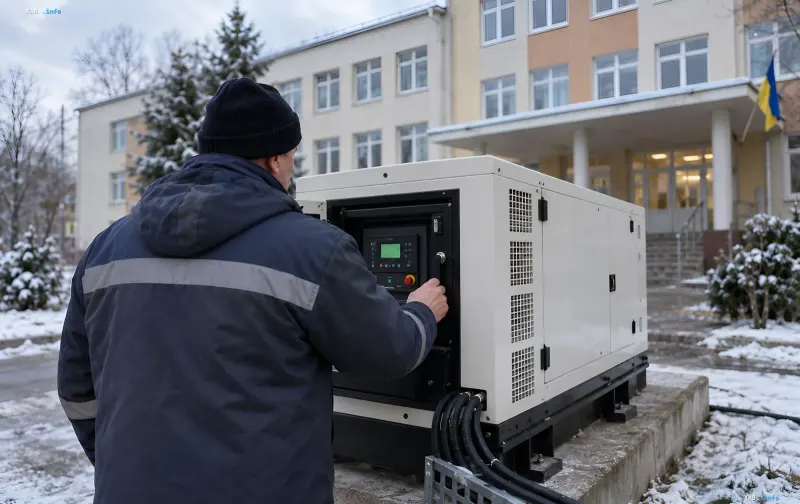
The Ministry emphasizes that having equipment is a necessary but insufficient condition. For full-fledged operation in autonomous mode, municipalities must ensure regular equipment maintenance, an uninterrupted fuel supply for generators, and the presence of responsible personnel capable of managing systems in emergency situations. Without these organizational components, even installed backup power sources do not guarantee the continuous operation of a school for eight hours or more.
Context: Infrastructure Investments in Education
The energy monitoring of schools fits into a broader cycle of infrastructure investments in the education sector. For instance, in Kyiv, 76 shelters in educational institutions were repaired over two years so that children could study in formats other than remote learning. Concurrently, enrollment in vocational pre-higher education institutions increased in 2026: 172,365 students were enrolled, which is 38,000 more than last year. The combination of these measures indicates that the state views the physical resilience of educational institutions as a key condition for preserving offline learning amid ongoing energy threats.