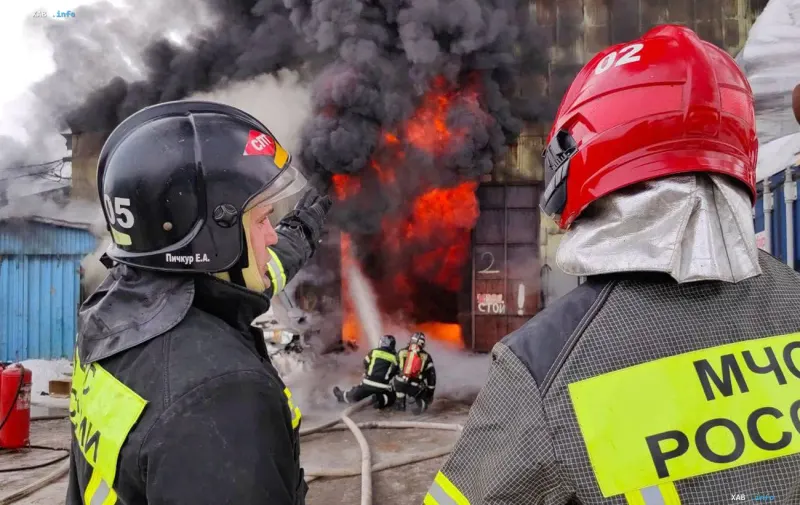
On the night of September 24, 2026, the Armed Forces of Ukraine carried out a series of strikes on oil refining and oil storage infrastructure facilities in the largest regions of Russia's Southern Federal District. According to the monitoring Telegram channel Exilenova+, confirmed by statements from local Russian authorities, oil depots in Rostov Oblast and Krasnodar Krai were hit by drones. That same morning, the Russian Ministry of Defense reported neutralizing 40 Ukrainian UAVs over several regions, including the ones mentioned.
Rostov Oblast: damage to the administrative buildings of an oil depot
The Governor of Rostov Oblast, Yuri Slyusar, officially confirmed that in the Kagalnitsky district, the administrative buildings of an oil depot were damaged as a result of the "falling UAV debris." The regional head stated that no fire broke out and that there were no casualties among the civilian population. Slyusar also reported that air defense systems allegedly destroyed the drones over Taganrog and the Neklinovsky district. The phrasing "falling debris" instead of a direct hit is characteristic of official Russian statements and is generally used to minimize the scale of the damage inflicted.
Krasnodar Krai: fire at a facility site
The operational headquarters of Krasnodar Krai acknowledged that a fire broke out on the territory of one of the enterprises in the Dinsky district due to falling UAV debris. According to the Telegram channel Exilenova+, this refers to an oil depot in the settlement of Novy Titarovskaya. Thus, strikes on oil infrastructure facilities in southern Russia are systematic in nature and affect both storage facilities and the administrative infrastructure of enterprises.
Russian MoD reaction and the scale of the attack
In the morning of September 24, the Russian Ministry of Defense stated that air defense forces shot down 40 Ukrainian drones over Rostov Oblast, Krasnodar Krai, as well as Bryansk, Belgorod, Kursk, and Tver Oblasts, and over occupied Crimea. Thus, the nighttime attack by the Ukrainian Armed Forces was extensive in nature and was directed simultaneously at several directions. The Russian military department did not disclose details about direct hits on infrastructure facilities, limiting itself to a report on "neutralized" drones.
Contradictory data
There is a discrepancy between various sources regarding the geographic location of the fire in Krasnodar Krai. The regional operational headquarters and the Telegram channel Exilenova+ point to the Dinsky district and the settlement of Novy Titarovskaya. At the same time, the publication Forbes, citing its own data, reports a fire at an oil depot as a result of a UAV attack on Sochi — a city located on the southern coast of Krasnodar Krai and administratively separated from the Dinsky district by hundreds of kilometers. Two explanations are possible: either on the night of September 24, at least two separate strikes were carried out on oil infrastructure facilities in Krasnodar Krai (one in the Dinsky district, the second in Sochi), or one of the sources made an error in locating the site. At the time of publication of this article, independent verification of the exact number of affected facilities in Krasnodar Krai is not possible.
Context: the situation at the front and Russian retaliatory strikes
The nighttime attack on oil depots in southern Russia occurred against the backdrop of ongoing active combat operations at the front. According to RBC-Ukraine, the Ukrainian Armed Forces advanced forward in three oblasts on September 24. At the same time, Russia carried out a massive strike on Ukrainian territory, which the Ukrainian air defense forces repelled throughout the night. Strikes on oil refining and fuel infrastructure facilities deep inside Russian territory, judging by the increasing frequency of such incidents, are becoming a stable element of the strategy of the Armed Forces of Ukraine, aimed at undermining the logistical support of the Russian military machine.