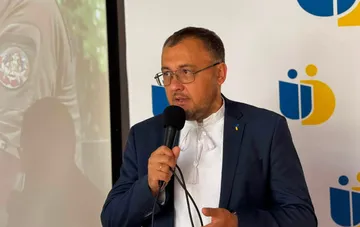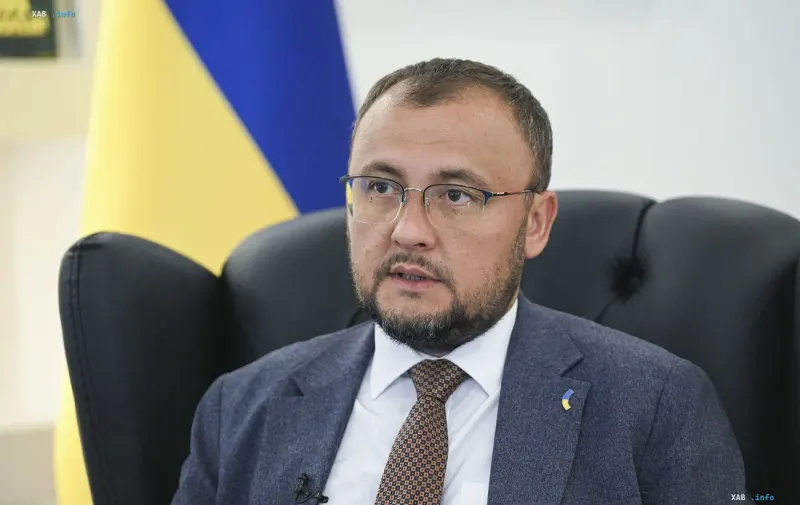
In the summer of 2026, relations between Kyiv and Warsaw went through one of the sharpest diplomatic crises in the history of the two countries. The trigger was the awarding of the honorary title "in memory of the Heroes of the UPA" to one of the Ukrainian units. In response, Polish President Karol Nawrocki stripped Volodymyr Zelenskyy of the highest state decoration — the Order of the White Eagle. Zelenskyy, in turn, sent the order to Warsaw via "Nova Poshta" (New Post), which triggered a wave of Ukrainian officials renouncing Polish honors. By September, the sharpness of the disputes had eased somewhat; however, as Ukraine's Ambassador to Poland Vasyl Bodnar emphasizes in a wide-ranging interview with RBC-Ukraine, the consequences of the crisis have not gone away, and preparations for the 2027 parliamentary elections are already turning historical disputes into a key element of the pre-election rhetoric.
The Order Crisis: How a Diplomatic Conflict Reached "Nova Poshta"
According to Ambassador Bodnar, the June episode became "one of the largest crises in bilateral relations." Every emotion, he notes, is like a wave: it has a peak and a trough. By mid-summer, the tension did indeed ease somewhat — even July 11, when Poland marks the day of remembrance of the "victims of the genocide committed by Ukrainian nationalists," passed without incidents. Over the past weeks, several meetings between the Ukrainian and Polish leadership at the highest level have taken place. Nevertheless, Bodnar warns directly: the lessons of the crisis must be drawn, and its social and political consequences are still felt in the everyday interaction of the two societies.
Volhynia as an Unhealed Wound and the Problem of Exhumations
The central node of bilateral contradictions remains the issue of the Volhynia tragedy of 1943–1944. According to the ambassador, Polish society takes a consolidated position and perceives the UPA and everything connected with its activity extremely negatively. An additional irritant is that, as Bodnar previously reported, Poland has blocked Ukrainian search operations at the burial sites of the victims of the Volhynia tragedy for months. Exhumations and the identification of remains remain one of the most sensitive points in the bilateral dialogue, and it is precisely here, in the diplomat's assessment, that both sides need to seek a compromise, without substituting it with propagandistic narratives.
Attacks on Ukrainians and Social Tension in Poland
The problem is not limited to "high politics." About two million Ukrainian citizens live in Poland, and over the years of the war this has created significant social tension. Bodnar points to a "constant stream of news about attacks on ordinary Ukrainians in Poland precisely on the basis of nationality." Sharp statements by Polish politicians on historical topics, he says, further agitate public opinion and create the ground for everyday aggression. The ambassador also notes that the theme of the UPA, Bandera, and Volhynia often overlaps with other, predominantly mythologized "grievances": that Ukrainians "take jobs," or that Ukrainian women "steal Polish men." The fight against "Banderaism," in his assessment, often serves as a convenient facade for a broader xenophobic discourse.
The 2027 Elections: History as a Political Weapon
In a year, in 2027, parliamentary elections will be held in Poland, and the pre-election campaign has, in effect, already begun. The theme of Ukraine, historical disputes, and the events in Volhynia is one of the key ones in this campaign. Bodnar warns that the intensification of the rhetoric of some Polish politicians — attributing non-existent benefits to Ukrainians, inflating the theme of agricultural produce from Ukraine, promoting narratives about the "disadvantage" of helping Ukraine in the war against Russia — is directly linked to the electoral agenda. In this environment, he says, the role of Russian propaganda, which systematically tries to "drive a wedge" between Polish and Ukrainian societies, cannot be ignored.
Russia as a Common Enemy and the Logic of National Interest
Despite all bilateral problems, Bodnar emphasizes: Poland remains a critically important partner for Ukraine given geography, logistics in both directions, Warsaw's membership in the EU and NATO, as well as the million-strong Ukrainian diaspora. "Before making a particular decision, one must take into account one's own national interest and the sensitivity of a foreign partner," the diplomat formulates the principle by which, in his view, both sides should build their relations. At the same time, he says, in Warsaw they understand how much Poland's own security depends on Ukraine, and consider Russia a common enemy. "Poland has no other enemy but Russia," the ambassador summarizes, pointing out that it is precisely this factor that in the long term may outweigh historical and everyday frictions.
Contradictory Data
In assessments of the current state of Polish-Ukrainian relations, there are notable discrepancies. On the one hand, Ambassador Bodnar and a number of Polish observers note that "the peak of the crisis has already been passed": the sharpness of the disputes has decreased, meetings at the highest level have taken place, and July 11 passed without incidents. On the other hand, the same diplomat points to a "constant stream" of attacks on Ukrainians, the intensification of xenophobic rhetoric by politicians, and the systematic pressure of Russian propaganda. Thus, the formal diplomatic "cooling down" does not match the real social dynamics on the ground. Moreover, in open sources the degree of influence of the order crisis on the long-term agenda is assessed differently: some analysts consider it a one-off emotional outburst, while others, including the ambassador himself, emphasize that its consequences "have not gone away" and will accompany the 2027 pre-election campaign.