
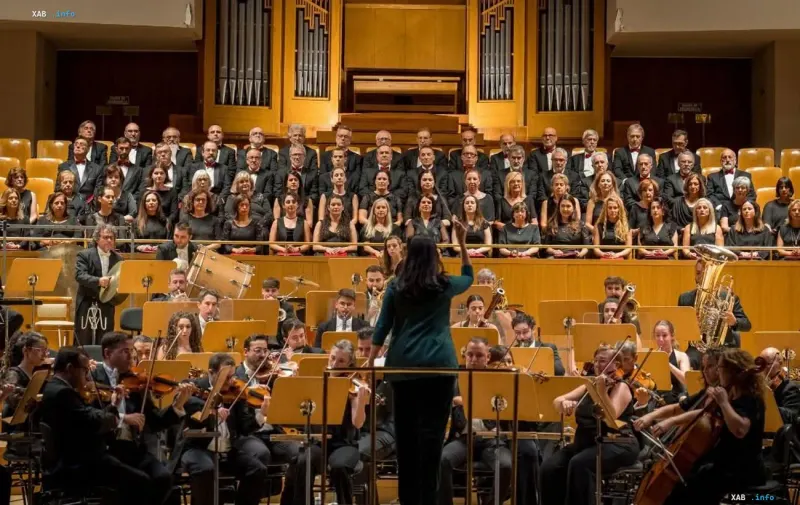
The Madrid Metropolitan Orchestra, together with the Talía choir, presented an unusual program in which popular Ukrainian songs that once represented the country at the Eurovision contest were performed in full symphonic format. The Spanish musicians did not merely accompany — they performed the compositions in Ukrainian, preserving the original lyrics and melody. This is reported by Wave RBC.UA, citing a post on the Threads social network.
Symphonic Interpretation: From «Stefania» to «Shum»
The evening's program featured four iconic compositions closely tied to Ukraine's participation in Eurovision: «Stefania» by Kalush Orchestra, «Wild Dances» by Ruslana, «Shum» by Go_A, and, perhaps the most recognizable for a wide audience — «Dancing Lasha Tumbai» by Verka Serduchka. Each track was reworked into an academic sound: orchestral parts, choral interludes, and instrumental improvisations turned pop hits into full-fledged symphonic numbers without losing their energetic core.
«Ziben, Ziben, Ai-Lu-Lu» in an Academic Sound
The greatest number of reactions on social media was generated by a fragment of the performance of Verka Serduchka's hit. The singers of the Talía choir performed the verse «Ziben, Ziben, Ai-Lu-Lu», familiar to the Ukrainian audience, while the Madrid Metropolitan Orchestra accompanied the composition with a dense academic sound. The contrast between the bright, almost carnival intonations of the original and the strict orchestral accompaniment creates an effect that users describe as both nostalgic and moving.
Reaction of the Ukrainian Audience
Clips of the performance quickly spread across Ukrainian social networks. In the comments, users admitted that they had not expected to hear «Dancing Lasha Tumbai» in exactly this format. Many noted that the symphonic reworking does not "kill" the song but, on the contrary, reveals new layers in it — from melodic depth to the emotional load that remains in the background in the pop version.
Recognition of Ukrainian Music Beyond the Country's Borders
The case of the Madrid orchestra is yet another confirmation of how recognizable the compositions associated with Ukraine's Eurovision have become beyond Ukraine's borders. The fact that Spanish musicians deliberately included exactly these tracks in the program and performed them in Ukrainian speaks to the fact that Ukrainian pop culture has firmly established itself in the international musical landscape. The symphonic interpretation, in essence, equates these hits with the classical repertoire — and this is the highest form of recognition of their artistic value.