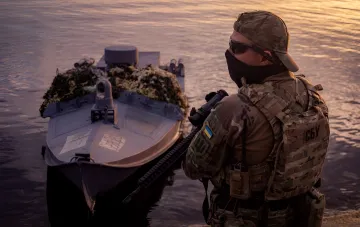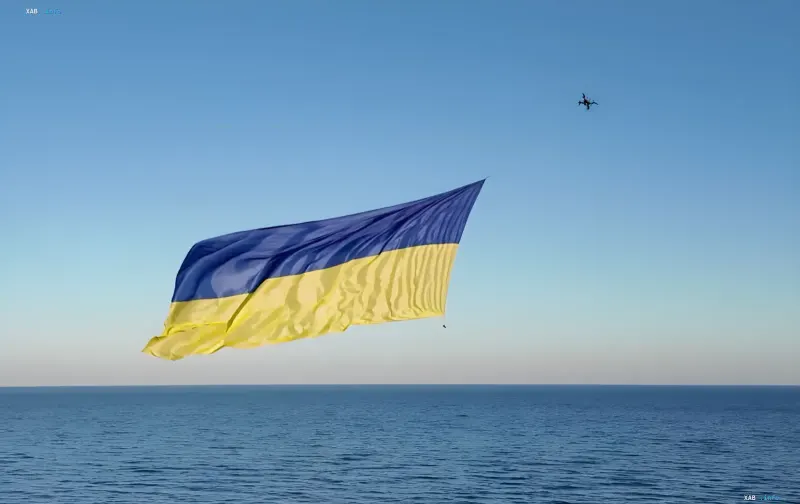
On August 23, Ukraine's National Flag Day, one of the largest state flags ever raised in this region unfurled over the waters of the Black Sea. According to RBC-Ukraine, citing the official Telegram channel of the State Border Guard Service of Ukraine, border guards of the Odesa detachment carried out a demonstration raising of the blue-and-yellow banner using an unmanned aerial vehicle. The event was timed to coincide with the national date and became a visual highlight of the celebrations on the Black Sea coast.
How the flag was raised over the sea
According to the border guards' statement, the 12-by-6-meter flag was unfurled directly over the Black Sea waters. The raising was carried out with the help of a drone, which allowed the banner to be lifted to a considerable height and out over the open sea, where it was clearly visible against the sky and the horizon. The SBGS emphasizes that this is the largest Ukrainian flag raised by a drone over Odesa Oblast — thus, the event is not only celebratory but also demonstrative in nature, showcasing the capabilities of the border service's equipment.
National Flag Day
Every year on August 23, Ukraine observes National Flag Day — a date enshrined in the calendar of national holidays. The blue-and-yellow banner is perceived by society as something self-evident and as if it had "always existed," yet, as experts note, behind this apparent simplicity lies a complex history. It is on this day that the symbol acquires special public significance: it is raised at institutions, in cities and, as in this case, over the open sea, turning it into an object of collective memory.
The history of blue and yellow: a century of debate and struggle
RBC-Ukraine turned to an expert in heraldry and vexillology, Yuriy Savchuk, Director General of the Museum of the History of Ukraine in World War II, to examine the origin of the blue-and-yellow combination. In his words, the flag's history is "a century of change, debate, and struggle for Ukrainian identity." In particular, discussions have repeatedly taken place in society and in academic circles over the order of the stripes — blue and yellow — and during the Soviet period the national symbols were persecuted and suppressed, which further accelerated the formation around the flag of a status as a symbol of resistance and self-identification.
A symbol over the sea
Raising a flag of such scale over the Black Sea on National Flag Day went beyond a simple ceremony: against the backdrop of the open waters and a clear sky, the blue-and-yellow banner, held in the air by a drone, became a powerful visual statement. The combination of a modern technical solution — a drone — and a historical symbol that has passed through a century of debate and suppression underscores continuity: the flag for which struggles over identity were fought in different eras is once again brought into the public space, this time — over the sea.