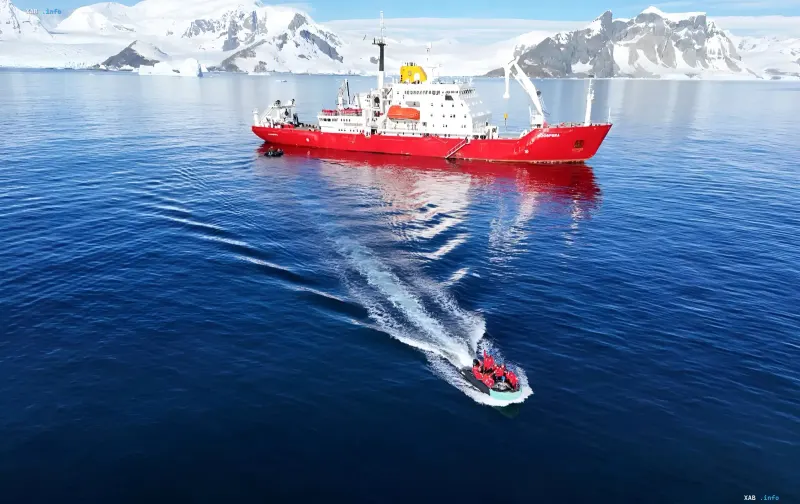
Ukrainian Antarctic infrastructure is becoming a key link in the global scientific network. The National Antarctic Scientific Center (NASC) has announced the launch of two large-scale international studies that will be conducted at the 'Academician Vernadsky' station and the 'Noosfera' icebreaker.
Both projects are being implemented under the POLARIN initiative, which is part of the 'Horizon Europe' program. This program aims to provide scientists from around the world with access to polar infrastructure. The launch of the studies is scheduled for the next Antarctic season, which will begin at the end of 2026.
The POLARIN Consortium and Ukraine's Role
The POLARIN project unites 64 polar research infrastructures belonging to organizations from various countries around the world. According to the consortium's rules, participants have free access to facilities provided through competitive selection. Ukraine has confirmed its status as an active member of the international scientific community by becoming the host for the first competition winners.
Two projects — MICROAIRPOLAR and TRICUSO-FLOATS — have been granted priority access to Ukrainian facilities. This will allow scientists to utilize the unique capabilities of the icebreaker and the permanent station to collect critically important data.
Project MICROAIRPOLAR: Who Lives in the Polar Air?
The first study, MICROAIRPOLAR, focuses on investigating the microbiological composition of the atmosphere. As part of the project, special MicroAirCollector equipment will be installed at the 'Academician Vernadsky' station. Its task is to collect samples of microorganisms from the air at various locations.
The collected samples will undergo genetic analysis to answer the question: 'Who exactly is the wind carrying into the polar regions?'. Additionally, using computational models, specialists will track the migration paths of these microorganisms.
The relevance of the project is due to the fact that microorganisms are the first to colonize surfaces that have just been freed from ice. In the context of the rapid melting of ice in polar regions, these microbes will play a key role in shaping future biodiversity. The project is being implemented by scientists from the Autonomous University of Madrid (Spain) and Northumbria University (UK).
Project TRICUSO-FLOATS: Carbon Balance of the Southern Ocean
The second study, TRICUSO-FLOATS, will be conducted in the open sea from aboard the 'Noosfera' icebreaker. As part of the project, six autonomous buoys (Argo floats) equipped with high-precision sensors are planned to be deployed.
These devices will measure total water alkalinity and dissolved inorganic carbon content. The data obtained will allow for a quantitative assessment of how much carbon the Southern Ocean absorbs.
According to preliminary data, the Southern Ocean absorbs about 40% of all CO2 held by the world's oceans. However, there are currently significant discrepancies between observational data and climate models of this process. Expanding the spatial and temporal coverage of autonomous measurements will help reduce this uncertainty and refine climate forecasts. The project is being implemented by a consortium of scientists from three institutions in different countries.