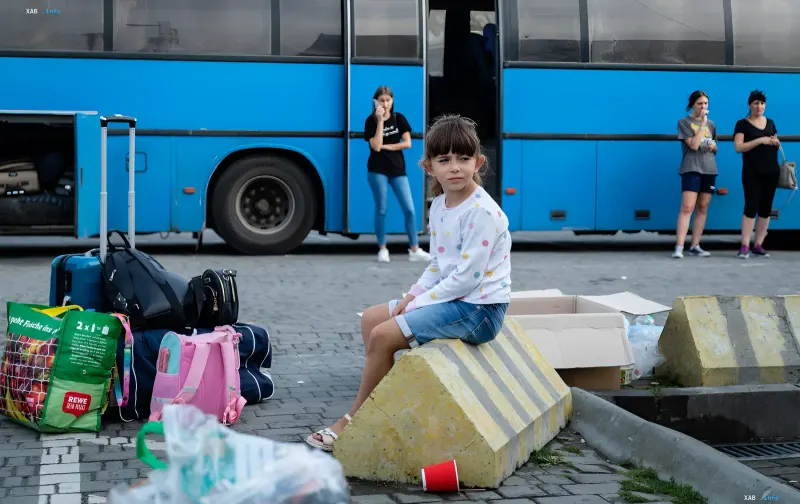
Ukraine's Foreign Intelligence Service (FIS) has reported the exposure of a well-established scheme for transferring children in state care from the temporarily occupied part of Donetsk Oblast deep into Russian territory. According to intelligence data, this summer a group of children from one of the occupied children's institutions was taken to Russia under the official pretext of "health improvement." However, not all of them returned home after the trip: at least two children were placed under guardianship and moved to the Moscow Region, effectively severing their ties with their previous place of residence and family. This is reported by RBC-Ukraine, citing the FIS.
"Health Improvement" as a Cover for Transfer
The FIS emphasizes that taking children abroad under the pretext of health improvement is just one variant of a well-established scheme. According to the service, such trips are also organized under the guise of "vacation," "rehabilitation," or "participation in cultural and educational events." The intelligence service claims that occupied administrations, Russian guardianship authorities, and third-party organizers are involved in arranging these trips. Upon arrival in Russia, the children come under the control of local authorities, who gain the ability to determine the child's place of residence and legal status. Thus, a trip initially presented as temporary may end with the child being moved to another region of Russia and placed under someone else's guardianship.
From State-Level to Criminal Dimensions
The FIS states that this is not an isolated case but a system in Russia for the exploitation of Ukrainian children, which, in their assessment, has both a state and a criminal dimension. The intelligence service attributes to the state dimension, in particular, the involvement of children in labor at defense industry enterprises and their recruitment by Russian special services. Among the criminal forms of exploitation, the service cites human trafficking, sexual exploitation, illegal organ transplantation, and other crimes. These statements underscore that the transfer of children is viewed not as a humanitarian matter but as a tool of pressure and resource exploitation.
Ideological Processing: A New Curriculum in Schools
The context of the exposed scheme is complemented by a statement from Dmitry Lubinets, the Ombudsman of the Verkhovna Rada for Human Rights, who previously noted that Russia uses schools in the temporarily occupied territories for the ideological processing of children. According to him, starting September 1, 2026, a mandatory course titled "History of Our Region. Donbas and Novorossiya" has been introduced for students in grades 5–7 in these territories, which, in the ombudsman's assessment, is aimed at imposing Russian imperial myths. In the view of Ukrainian authorities, the totality of these facts indicates the systematic nature of the policy toward children in the occupied territories.
Contradictory Data
It is important to note that all the information presented comes from statements by Ukraine's Foreign Intelligence Service, conveyed through RBC-Ukraine. The provided materials contain no comments from the occupied authorities, Russian guardianship bodies, or trip organizers, nor any independent confirmation of specific cases of children being transferred to the Moscow Region. Thus, the version of a "kidnapping scheme" and the scale of exploitation rests on one-sided intelligence data, while the opposing side has not publicly commented on these claims in available sources. Until independent verification and a response from the other side are obtained, the factual details—including the exact number of children and the circumstances of their placement under guardianship—remain at the level of claims by one of the parties to the conflict.
The situation underscores the acute problem of protecting the rights of children in the temporarily occupied territories and the need for international attention to the mechanisms of transferring minors. The Ukrainian side insists that the exposed scheme requires an investigation and the prosecution of its organizers, while, without access for independent observers and public data from the Russian side, the full picture remains limited.