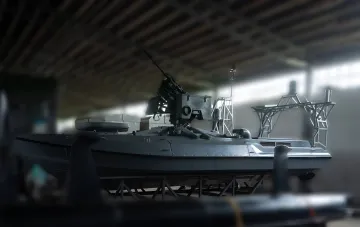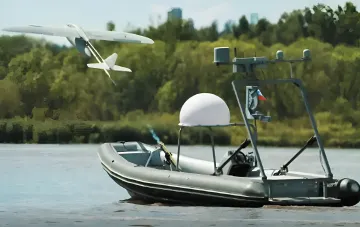
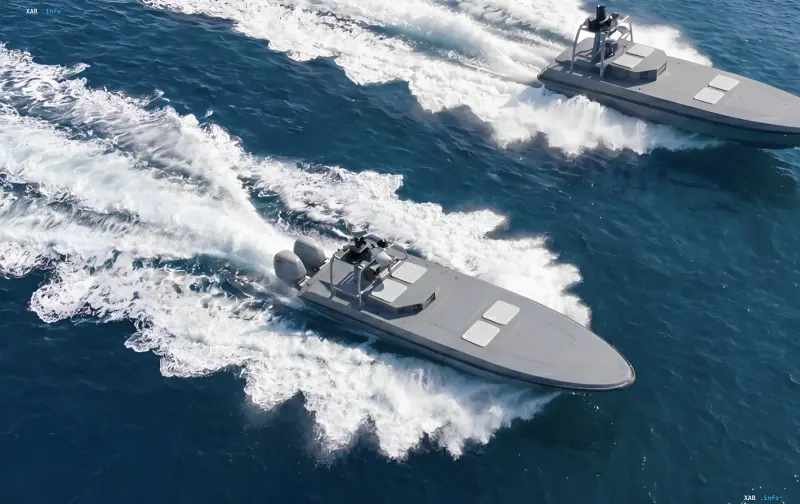
The Ukrainian Navy, jointly with one of the SBU's special units, carried out a successful special operation in the Black Sea. Near Snake Island, Ukrainian military forces detected an enemy unmanned boat and struck it. After being hit, the craft caught fire and detonated, resulting in the destruction of the target. According to Kyiv, the target was the multi-functional unmanned boat 'Kama' — one of the latest developments of the Russian defense industry.
Joint Navy and SBU Operation Near Snake Island
The special operation in the Black Sea was carried out by the forces of two structures: Ukrainian Navy personnel and the staff of one of the SBU's special units. It was in the area of Snake Island, which has remained a key point of control over the Black Sea direction since the first days of the conflict, that Ukrainian military forces detected an approaching unmanned boat. After being hit, the boat caught fire and exploded, which, according to Kyiv's statements, confirms the complete destruction of the target. The joint conduct of such operations reflects the practice of coordinating naval and special forces in intercepting the enemy's maritime drones.
What Is the 'Kama' and Who Developed It
The multi-functional unmanned boat 'Kama' is a development by the company ZALA, part of the Kalashnikov Concern. The craft was officially unveiled for the first time on June 11, 2026, at the International Naval Salon 'Flot-2026' in Kronstadt. According to the manufacturer, two modifications of the boat were showcased at the salon. Thus, the craft destroyed near Snake Island belongs to a series that was publicly demonstrated only a few months earlier, underscoring the high speed at which new maritime drones are being brought into combat service.
Dual-Use Purpose and Positioning
According to ZALA's official release, the 'Kama' is positioned as a dual-use craft. On the one hand, the manufacturer claims it is applicable for hydrographic work, environmental monitoring, and cargo delivery. On the other hand, the boat is intended for patrolling and carrying out so-called 'special tasks,' which effectively points to combat use. The specific numerical characteristics listed in the company's release are presented in a generalized form in open reports, so the text relies on the manufacturer's confirmed positioning of the craft as a multi-functional dual-use platform.
Broader Context: Confrontation in the Black Sea
Attacks on maritime unmanned boats remain a constant feature of the confrontation in the Black Sea. In late July to early August 2026, the Defense Forces struck a storage and maintenance base for maritime unmanned boats in the area of Chersones in occupied Crimea. It was there, according to Ukrainian military data, that the Russians prepared and maintained boats for combat and special tasks in the Black Sea. The destruction of the 'Kama' near Snake Island fits into this logic: both sides simultaneously attack the craft themselves at sea as well as their onshore infrastructure.
Contradictory Data
In the context of maritime drones, open sources contain diverging accounts. Thus, during July 2026, the Russian side claimed to have destroyed as many as five Ukrainian maritime drones off the coast of Romania. However, according to Ukrainian data, these were craft that, under the influence of Russian electronic warfare jamming, lost control and were carried off their planned route into neutral waters. In other words, one side characterizes these episodes as the 'destruction of enemy drones,' while the other — as incidents involving its own craft that drifted due to electronic countermeasures. Such a discrepancy in interpretation is typical of the information confrontation in the Black Sea and calls for caution when assessing each individual episode.
Either way, the incident near Snake Island confirms that maritime unmanned boats — both Russian and Ukrainian — have become a full-fledged instrument of the Black Sea confrontation, and their interception and destruction have turned into a routine but high-risk task for both sides.