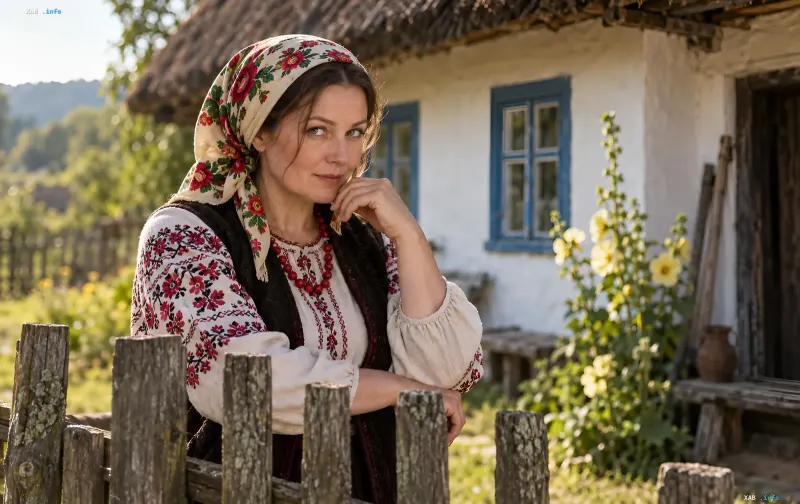
On the eve of Halloween celebrations, when shop windows and social media are dominated by imagery of pointed black hats and broomsticks, Ukrainian folklore offers a fundamentally different picture. Folklorist and scientific editor of the Vitoky project (Zagoriy Foundation) Daria Antsibor, in a conversation with the Styler publication (RBC-Ukraine), explained that in Ukrainian folk beliefs, a witch had no 'recognizable' appearance. She wore the ordinary clothing of her community, lived next door, and it was precisely her—a familiar woman—whom people suspected of holding supernatural powers. This thesis, confirmed by ethnographic materials, shatters the persistent stereotype formed by European pop culture and cinema.
The Neighbor, the Lonely Woman, and the 'Tail Near the Coccyx'
According to Antsibor, a Ukrainian witch did not look outwardly different from other village women. Suspicions typically fell on a neighbor or a lonely woman who did not fit into the customary social structure. In some local beliefs, she was attributed hidden physical traits: a small tail near the coccyx, multicolored eyes, or excessive body hair. In several regions, the tail was considered a sign of a so-called 'born' witch, as opposed to a 'learned' one. The folklorist links the very word 'vedma' (witch) to the verb 'vedaty' (to know), emphasizing the cognitive rather than the external nature of the gift attributed to her.
'Household Harm': Milk, Dew, and Rain
A significant portion of Ukrainian beliefs concerned not appearance, but specific actions attributed to the witch. Her harm, in Antsibor's words, was primarily economic: she took milk from other people's cows, collected dew from other people's pastures, sent illnesses, and could influence rain. It was precisely these 'everyday' accusations—rather than abstract evil—that formed the core of popular beliefs about witchcraft. The most active days for a witch were considered to be St. George's Day, Ivan Kupala, and Christmas Eve, which are the key points of the traditional agricultural and religious calendar.
Bald Mountain, a Pitchfork, and a Ball of Yarn
Ukrainian beliefs endowed the witch with the ability to change her shape: she could turn into a cat, a dog, a frog, or physical objects such as a ball of yarn or a haystack. Various means were used to fly to Bald Mountain, the central motif of Slavic witchcraft folklore: a pitchfork, a broomstick, or even riding on a human's back. Thus, the broomstick was present in Ukrainian representations, but it was only one of several possible 'transports' rather than an obligatory attribute, as in the later European stereotype.
Holy Water, Poppy Seeds, and Crosses on Doors
Drawing on ethnographic materials, Antsibor lists folk remedies for protection against the influence attributed to the witch: holy water, poppy seeds, aspen, and chalk or burned crosses on doors. These objects and signs, she says, belonged to a system of folk practices through which people combated their own fears and believed they were protecting themselves and their households from disasters. The folklorist emphasizes that this is not 'magic' in the modern sense, but a cultural mechanism for managing anxiety under conditions of limited control over nature and the household.
The 'Vitoky' Project and the Book 'Family Christmas for Everyone'
Vitoky is a project by the Zagoriy Foundation's social practices laboratory that explores past traditions and their place in modern life. Together with Kateryna Osadcha's Foundation and the Stretovych publishing house, the team prepared the book 'Family Christmas for Everyone', with Daria Antsibor serving as its scientific editor. The publication contains stories about Christmas customs, celebration scenarios, and QR codes with carols and master classes. The book's release in bookstores is scheduled for November 20, 2026. The material was prepared based on a publication by Styler, an entertainment and lifestyle project by RBC-Ukraine.