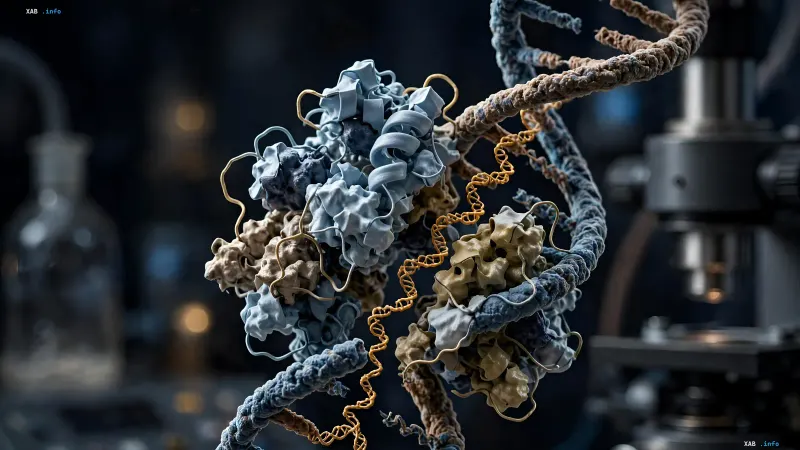
The CRISPR-Cas family has become the primary genome-editing tool of the past decade; however, a group within it was long considered 'defective.' Cas12m proteins—a compact subclass of molecular 'scissors'—are capable of recognizing and binding to specific DNA segments, but previous data suggested they lacked the ability to cut genetic material. This rendered them practically useless as gene-editing tools, despite the fact that their small size could significantly simplify delivery inside cells, one of the key challenges in modern gene therapy. This exact paradox—small size combined with a lack of catalytic activity—served as the starting point for an international team led by researchers at the University of Tokyo.
Systematic Screening in Escherichia coli: Searching for the Seemingly Non-Existent
The researchers developed a specialized screening system based on the bacterium Escherichia coli, which allowed for the high-throughput testing of various Cas12m variants for their ability to cleave DNA in the presence of a guide RNA. As a result of this screening, two proteins—UnCas12m3 and UnCas12m4a—were isolated, demonstrating full catalytic activity. This discovery showed that the inability to cut is not a universal trait of the entire Cas12m group: some of its members do possess this potential, which had simply gone unnoticed previously due to the lack of an appropriate screening method.
Cryo-Electron Microscopy Reveals the Mechanism of 'Molecular Scissors'
To understand exactly how active proteins differ from inactive ones, the team applied cryo-electron microscopy, a technique that allows for the determination of three-dimensional structures of molecular complexes at atomic resolution. Comparative analysis of the structures of active and inactive Cas12m variants revealed a fundamentally important mechanism: the mere presence of the RuvC catalytic center, responsible for cleaving phosphodiester bonds, is not enough. Successful DNA cleavage also requires a specific two-step deformation of one of the nucleic acid strands. It is this conformational rearrangement that creates mechanical stress near the cleavage site, enabling the enzyme to 'snap' the strand. In inactive proteins, such deformation does not occur, and the catalytic center remains inefficient.
Protein Engineering: Restoring Activity Through Mutations
Building on these structural insights, the researchers performed targeted amino acid substitutions in the inactive proteins TfCas12m3 and MmCas12m2. As a result, they successfully restored the DNA-cleaving ability of these variants. This result has a dual significance: on the one hand, it validates the structural model proposed based on cryo-EM; on the other hand, it paves the way for the targeted engineering of novel active Cas12m variants without being limited to natural forms. Instead of screening thousands of natural proteins, scientists can now make targeted changes to specific elements of the molecular structure and 'turn on' the catalytic function where it was previously absent.
Prospects and Limitations: The Path to a Universal Tool
The study also included a preliminary evaluation of the potential of the discovered proteins for genome editing. Nevertheless, the authors emphasize that creating a universal and practical tool is still a long way off: it is necessary to increase the efficiency and precision of DNA cleavage, as well as to determine how well the compact proteins function in various cell types and whether they are suitable for real therapeutic tasks. However, the main result of this work—the discovery of active Cas12m variants and the elucidation of the structural principles that allow inactive variants to be turned into fully functional molecular scissors—significantly expands the arsenal of tools available to scientists and opens new directions for gene editing using ultracompact proteins.