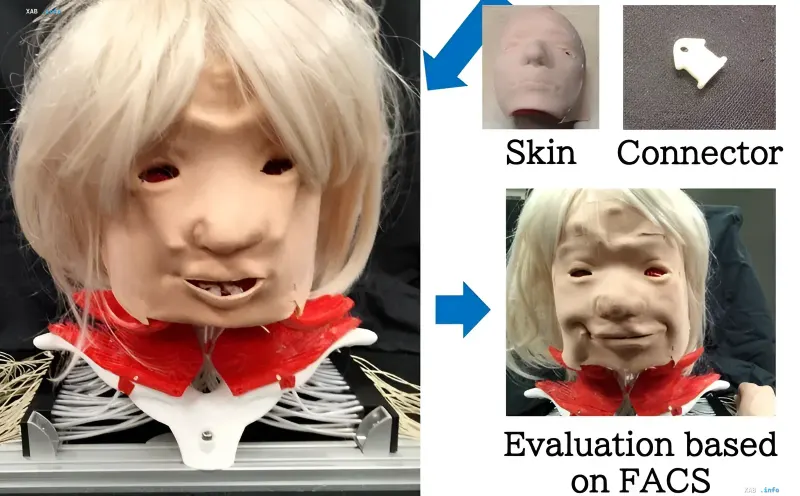
Researchers at The University of Tokyo have unveiled a robotic model of a human face that accurately replicates its anatomy and is capable of displaying lifelike expressions. A key challenge of the project was developing a muscle actuation mechanism where the motors themselves are placed outside the facial area — there simply isn't enough space volume-wise to fit all the actuators and linkages required for a full range of expressions.
The Problem Solved by Japanese Engineers
Robots that simulate human facial expressions already exist, but current models cannot display the full spectrum of basic movements of facial muscles and skin. To replicate a full set of expressions would require so many actuators and linkages that they physically would not fit inside the machine's facial structure. Therefore, the engineers decided to fully recreate the muscle structure responsible for facial expressions while moving the muscle control outside the robot's head.
How the «Muscle» System Works
The design features 65 artificial muscles representing 34 anatomical types. Their placement, geometry, and attachment points were determined based on volumetric anatomical atlases. The muscle elements are made of thermoplastic polyurethane (TPU) in a zigzag structure, allowing them to contract and stretch. Contraction is achieved by tensioning control cables routed through polytetrafluoroethylene (PTFE) tubes. This exact scheme allows the actuation mechanisms to be placed outside the robot's face. The silicone skin is cast in separate sections, and the muscle simulators are attached to it from the inside.
Evaluation Using the FACS System
Evaluation was based on the 1978 Facial Action Coding System (FACS), which describes facial expressions using 47 separate Action Units (AUs) representing individual movements of facial parts. In the first phase, researchers manually tensioned the control cables without the skin installed: they successfully reproduced 40 out of 47 basic movements, including eyebrow raises, lower jaw movement, eyeball movement, and tongue protrusion. After installing the silicone skin, only 30 movements could be reproduced. However, the robot was able to demonstrate human-like expressions: protruding the chin, raising and lowering mouth corners, wrinkling the nose, and more.
Limitations and Future Plans
The current version also has notable drawbacks. For instance, blowing up cheeks and creating certain lip movements will require a pneumatic actuator, which is absent in the current design. Insufficient elasticity of the silicone skin and the specifics of muscle attachment to the eyelids prevent full eye movement — specifically, the robot cannot yet close its eyes. In the future, researchers plan to transition to more complex expressions involving a greater number of muscles and hope to replace manual control with remote actuators.