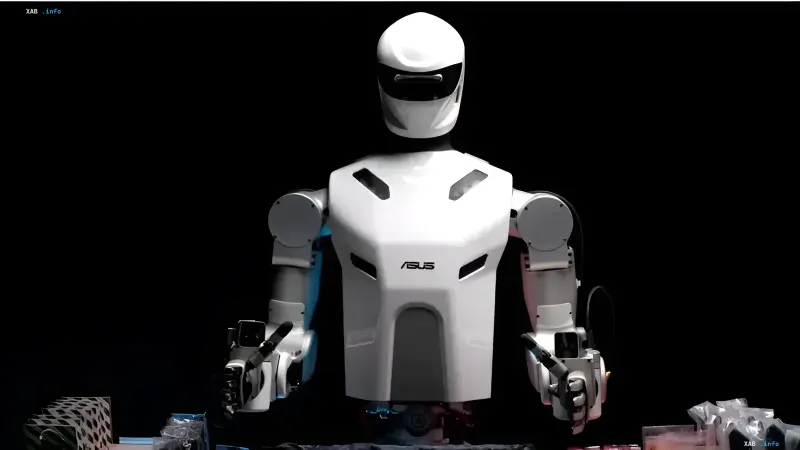
Taiwanese corporation Asus has announced the unveiling of Gallop, its first humanoid robot designed to perform manufacturing operations in the electronics industry. As of the publication date, the robot is undergoing testing at Asus's own factory, where it is learning to pack boxes with motherboards. The task assigned to Gallop during the initial training phase involves organizing 15 different components into boxes, many of which are small parts in thin, transparent plastic bags. The duration of one operation is approximately 20 seconds per motherboard, with a target accuracy of 99.5% while adhering to time standards.
Architecture: Four levels of software control based on Nvidia Jetson AGX Thor
Gallop is a humanoid torso with two manipulator arms mounted on a fixed base. The robot's software and hardware platform is built on a single Nvidia Jetson AGX Thor computing module located directly inside the body. The software architecture is divided into four levels: a planner analyzes the environment and breaks the task into a sequence of actions; a separate oversight system monitors operations and revises the plan if necessary; a skills level is responsible for movement, grasping, and object placement; and a control level manages the hands and manipulators directly. Fixed interfaces are provided between the levels, allowing AI models to be swapped without completely redesigning the robot.
Training: From observing operators to VR-control
Gallop's training process combines several methods. First, the robot observes experienced employees who, with their consent, use small head-mounted cameras to record manufacturing operations. Then, a software simulation generates variations of recorded actions, helping the system adapt to changing conditions. Additionally, an operator in a VR headset and gloves can directly control the robot while performing operations with the same parts and cameras used in the actual workplace. This multi-level approach to training is intended by the developers to accelerate the transfer of skills to other robots and reduce training time for autonomous labor.
Hardware: Proprietary manipulators and outsourced components
Asus develops the robot's body and manipulators itself, including tactile-sensitive hands and fingers. Motors and other standard components are sourced from third-party suppliers. Over the next year, Asus plans to equip Gallop with its own multi-fingered hand with tactile sensitivity, install it on a wheeled platform, and demonstrate it to potential customers at Computex 2027.
Timeline: From the 2026 launch to market arrival in late 2028
The Gallop development program started in early 2026, less than a year ago. Pilot projects with clients are scheduled for 2027, with a full market launch expected in the second half of 2028. The initial area of application will be electronics manufacturing, though the company is considering the future use of Gallop in hospitals and other service sector institutions. Asus emphasizes that the robot is not intended to take jobs away from humans, but rather to free them from the monotonous, routine operations that currently occupy a significant portion of working time on production lines.