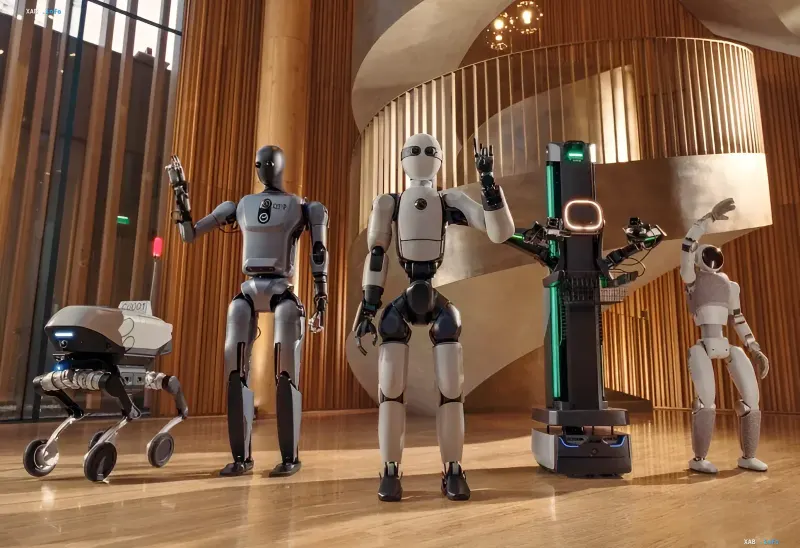
At the AI Journey international conference, Sber presented a new lineup of robots built on its proprietary GreenVLA 2.0 neural network platform. The family includes three fundamentally different platforms: the humanoid robot 'Green' 2.0 for complex object manipulation, the athlete robot Juni specializing in choreographic and acrobatic stunts, and an unnamed wheel-legged delivery robot capable of overcoming curbs, stairs, and other urban obstacles. According to the developers, all three machines operate under a single artificial intelligence model and demonstrate various facets of physical AI development—ranging from precise manipulations to movement coordination and solving applied tasks in an urban environment.
'Green' 2.0: Humanoid All-Rounder for Manipulation
According to Sber's press release, the humanoid robot 'Green' 2.0 is designed for tasks combining spatial movement and object interaction. Thanks to coordinated control of arms, legs, and torso, the machine is capable of executing complex action sequences. Compared to the previous version, 'Green' 2.0 features an increased number of degrees of freedom and higher load capacity: its more flexible design allows the robot to perform complex movements and learn new physical skills, which, according to its creators, expands the range of tasks it can solve.
Juni: Athlete Robot Stepping Onto the Ice with an Olympic Champion
Sber engineers use the athlete robot Juni to practice physical AI skills—precise body control, movement coordination, and balance maintenance. Juni is capable of complex dynamic movements, including choreographic and acrobatic elements. According to the company, Juni became the world's first robot to take part in an ice show: it stepped onto the ice alongside Olympic champion Anna Shcherbakova, performed dance combinations, and demonstrated how technology combines with art in interaction with its partner.
'Last Mile' Courier: Wheel-Legged Platform
The remaining unnamed delivery robot for the 'last mile' is undergoing pilot testing in one of Moscow's districts. As explained in the press release, the special wheel-legged platform successfully overcomes curbs, stairs, and other urban obstacles, and its design is engineered to operate in both rain and snow. In the future, Sber stated, such robots will be able to deliver orders right to the door, overcoming obstacles inaccessible to conventional wheeled robots.
Single Neural Network and In-House Component Production
All presented robots are built on a single artificial intelligence model, GreenVLA 2.0, under whose control the machines gradually practice interacting with the physical world. The platform's development is accompanied by the expansion of in-house component production at Sber's robotics center. 'Today we are presenting three robot platforms at once with a shared AI model. It is important for us that robots can independently perform useful work for humans. We are actively testing our technologies in retail and delivery, and our experiments in art, ballet, and sports expand the boundaries of what is possible. We are also developing our own engineering base and component production in Russia. All of this forms the foundation for the development of robotics in our country and our economy,' said Sber CEO German Gref.