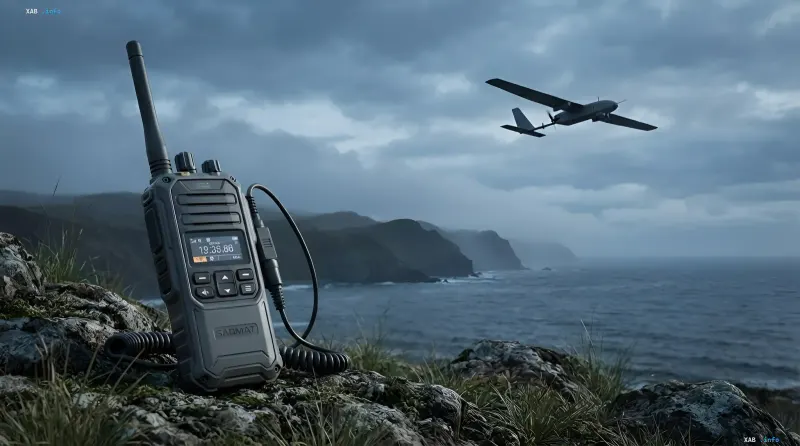
Field tests of the new Zala Ural-25S radio station, developed for the needs of special and emergency services, have been completed on Sakhalin. The key objective of the test campaign was to check how the system performs in conditions where there are neither cellular towers nor internet access. During the tests, stable radio communication was established between a border patrol vessel and the command and control post of the Pushistiy drone port. Signal transmission along the route was handled by a repeater installed onboard a Zala T-16 unmanned aerial vehicle, effectively turning the drone into a mobile relay point in open sea and coastal areas.
Self-Organizing Network Instead of Stationary Infrastructure
The main technical difference between the Ural-25S and classical field radio stations is its ability to automatically form a self-organizing peer-to-peer (mesh) network with multi-hop relaying. In such an architecture, each terminal can act as an intermediate node: having received a signal, it transmits it further down the chain to the final recipient. This allows the coverage area to be expanded without building towers, base stations, or laying cables—the network "grows" as new devices are connected and mobile relays, including those on drones, move around.
Seven Days of Standby Autonomy
An important operational parameter confirmed during the tests was the device's battery life: in standby mode, the radio is capable of operating for up to seven days without recharging. For prolonged operations far from power sources—on the sea coast, in field conditions, when deployed in unlit and hard-to-reach areas—this means that the operator can rely on a stable communication channel throughout the entire shift and several days of reserve without organizing power supply logistics.
Integration with Offline Maps "ZOV Karty"
The radio station integrates with the domestic mobile geoinformation complex "ZOV Karty," which operates without an internet connection. Coupled with the radio station, this allows for the deployment of an autonomous coordination system: the positions of operation participants, hazardous zones, and assigned tasks are displayed in real time on a common map. Services are able to exchange operational information and monitor the situation even in the complete absence of cellular communication, which is critical for operations in remote areas, over water, and in zones where communication infrastructure is absent or destroyed.
What This Means for Emergency Services
Combined, the demonstrated capabilities—mesh relaying via drones, multi-day autonomy, and offline geoinformation coordination—form a connected command loop that does not depend on commercial telecom operators. For border, rescue, and other emergency services, this means the ability to build their own reliable communication and data exchange network at any point of responsibility, including over water and in the coastal zone, where stationary infrastructure is either absent or cannot be promptly restored. The further development of such systems, according to the logic of the tests, involves expanding the fleet of mobile UAV relays and deepening integration with geoinformation complexes.