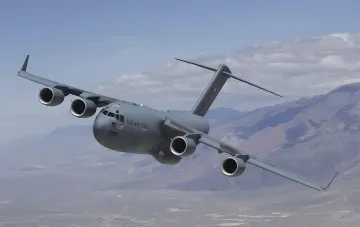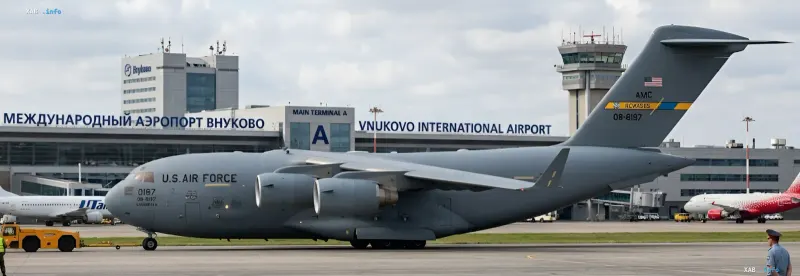
On the morning of August 25, 2026, the US Air Force heavy military transport aircraft Boeing C-17 Globemaster III, tail number RCH4555, landed at Vnukovo Airport in Moscow. According to flight tracker Flightradar24, the aircraft departed Riga at 08:50 Moscow time and completed its flight to the capital at around 10:04, after which its signal ceased to be tracked by civilian systems. According to the same data, the aircraft's route began at Joint Base Andrews in Maryland, USA: the plane had arrived in Riga on August 23, where it stayed for about two days before the flight to Russia. Neither official US agencies nor the Russian authorities have publicly disclosed the nature of the cargo, the passenger manifest, or the purpose of the flight, which turns the event into a subject of expert rather than confirmed interpretation.
Flight Timeline and Logistics
The logistics chain of the flight — Maryland, Riga, Moscow — points to a multi-stage government operation rather than a direct transit flight. The two-day intermediate stop in Riga is characteristic of operations requiring refueling, technical inspection, or synchronization with other mission participants. The very fact that tracking ceased after landing at Vnukovo is consistent with standard practice for government and military aircraft whose coordinates are not transmitted to open aviation surveillance systems.
Aircraft Status and the Significance of Joint Base Andrews
The Boeing C-17 Globemaster III is a multi-role heavy transport aircraft with a maximum payload of approximately 77.5 tons, designed for the rapid deployment of troops, strategic cargo, and heavy equipment. A key marker of the mission's status is the point of departure: Joint Base Andrews is the principal government airfield of the United States, home to the presidential aircraft fleet, including the Air Force One aircraft. The association of the flight with this base indicates a governmental rather than purely military character of the operation, narrowing the range of possible scenarios to state-level tasks.
Precedents and Historical Context
According to available data, this is the first recorded instance of a similar heavy US military aircraft arriving in Moscow in recent years — since 2017. The nearest comparable precedent dates to February 2025, when a US government Gulfstream C-37B business jet landed at Vnukovo, used in a prisoner exchange operation (Alexander Vinnik for American teacher Mark Fogel). Thus, the appearance of the C-17 fits into a narrow series of episodes in which US government aviation is used for tasks that go beyond ordinary diplomatic protocol.
Assessments and Unofficial Accounts
Observers identify two main unofficial scenarios. The first is linked to the preparation of diplomatic contacts: the use of an aircraft from Joint Base Andrews may indicate the delivery of an advance team, communications equipment, or government cargo ahead of a visit by high-ranking mediators, among whom US Presidential Special Envoy Steve Witkoff and Jared Kushner have previously been mentioned. The second scenario assumes a technical mission of the embassy or a new stage of prisoner exchanges, for which transport aircraft of this class are used when moving protected vehicles and specialized equipment. It should be noted separately that rumors circulating in the media space linking the flight to commercial artists, in particular Kanye West, are not corroborated: heavy US military transport aircraft are not used to move private individuals.
Contradictory Data
The public domain contains an inconsistency in the nature of the official reaction. On the one hand, a number of publications note that official US and Russian agencies are not commenting on the purpose of the visit, the nature of the cargo, or the passenger manifest. On the other hand, certain Russian sources cite a comment by Russian President's Press Secretary Dmitry Peskov regarding the landing, and Deputy Kolesnik publicly called the landing a "not a bad sign." Thus, the fact of the landing is confirmed by flight tracking and the media, but its official interpretation is either absent or contradictory: one set of sources speaks of complete silence from the agencies, while another points to the existence of limited official and semi-political assessments. None of the versions reveals the essence of the mission, which makes all analytical scenarios hypothetical.
Long-Term Consequences and Legal Aspects
From a macro-political perspective, the appearance of a US government aircraft on Russian territory against the backdrop of a deep crisis in bilateral relations signals the preservation of channels for resolving matters of state importance that require direct logistics outside standard diplomatic mechanisms. From a legal and aviation standpoint, the landing of a military aircraft requires coordination of airspace and the issuance of permits, which in itself confirms the institutional rather than improvised nature of the flight. Until official statements from both sides emerge, any specific claims about the purpose of the mission remain a matter of expert discussion rather than a confirmed fact.