

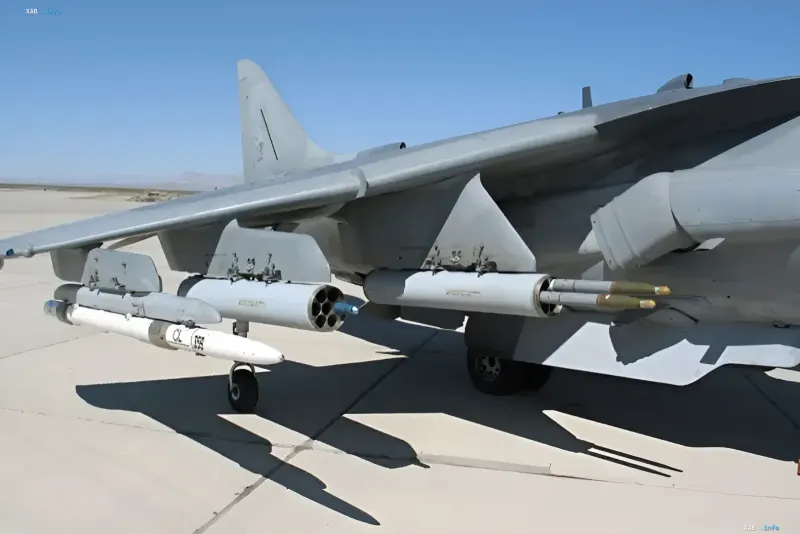
On August 23, the US government approved a potential contract worth $364 million for the supply of 5,031 specialized APKWS II systems to Italy, Rome-based correspondents of the Vietnam News Agency reported, citing the newspaper La Repubblica. In essence, these are guidance modules that turn ordinary unguided 70-mm rockets into "smart" munitions capable of independently detecting and engaging targets, including unmanned aerial vehicles. The approved deal became one of the notable episodes in a string of transnational defense procurements that, against the backdrop of the spread of next-generation drones, are rapidly reshaping the arsenals of NATO countries.
What is APKWS II and how does it work
The APKWS II system is a laser guidance module mounted on the rocket's four control stabilizers. It is these sensors that correct the flight trajectory, improving hit accuracy. Although the base rocket was developed about 15 years ago to engage ground targets — armored vehicles, artillery, firing positions — since 2022 APKWS II has quickly become one of the effective means of counter-drone warfare. The stated range of action is about 5 kilometers, and the key advantage is the combination of accuracy and low cost.
The economic logic: why not shoot a drone down with millions of dollars
The main argument in favor of APKWS II is economic efficiency. Each kit for upgrading an unguided rocket costs around $15,000–22,000, making it many times cheaper than expensive air-to-air missiles, whose cost is measured in millions. This allows operators to avoid spending premium munitions on destroying relatively inexpensive drones, which is especially relevant in tension zones such as the Red Sea or the Persian Gulf, where the mass use of UAVs has become the norm. The purchase of 5,031 systems for $364 million thus looks like a bet on massive but cheap countermeasures against the drone threat.
Integration into Italian forces
The new systems are expected to be installed on Eurofighter fighters of the Italian Air Force, as well as on AW249 Fenice combat helicopters of the ground forces. This approach will improve the level of protection against air penetration threats at different altitudes and from different platforms — from tactical helicopters to frontline fighters. For Rome, this is a step toward creating a multi-layered counter-UAV system combining aerial and ground means.
Limitations and risks
Experts, however, note that even a significant procurement package does not solve all the problems. APKWS II is mainly effective against slowly flying propeller-driven drones, whose speed is about 100 km/h. At the same time, many next-generation drones are equipped with turbojet engines and reach speeds of over 500 km/h, which calls into question the system's applicability against them. In addition, the rapid pace of UAV technology development — updates every 6–9 months — creates a dilemma for Italy regarding long-term investments: weapons purchased today risk becoming obsolete before they pay for themselves.
Context: Poland and "PIORUN"
Against the backdrop of the Italian deal, a parallel process in Poland is worth mentioning. On August 24, at the "Mesko" plant in Skarżysko-Kamienna, in the presence of Deputy Prime Minister and Defense Minister Władysław Kosiniak-Kamysz, a framework agreement was signed for the supply of thousands of "PIORUN" man-portable air defense systems. More than 80% of the ordered missiles and launchers are intended for the Polish army, while about 20% are for other NATO member states under the joint SAFE procurement program. "PIORUN" is a Polish MANPADS developed as a significant upgrade of the "GROM" system, which in turn traces its origins to the Soviet "Igla" complex. Both cases — Italy's and Poland's — reflect NATO's common trend toward massive, multi-layered, and relatively cheap counter-drone measures.
Contradictory data
The provided materials contain several inconsistencies that should be taken into account. First, the cost arithmetic does not add up cleanly: if the stated kit price ($15,000–22,000) is multiplied by 5,031 systems, the result is around $75–110 million, not $364 million. This means that either the total contract amount includes, in addition to the guidance modules themselves, the rockets, integration, training, and logistics, or the "per kit" price refers only to the laser module and not to the full munition set. Second, in the photo caption the system is called an "American APKWS-II air defense missile complex," whereas in the text it is described as a guidance module for a 70-mm rocket originally intended for ground targets. These differences in wording do not negate the fact of the approved deal, but they indicate that the exact composition and structure of the $364 million package should be clarified with primary sources.