Amid a global artificial intelligence boom and record demand for high-speed memory, relations between the US and South Korea in the semiconductor sector are taking an unexpected turn. Washington, according to sources, has lodged claims against the largest South Korean chip manufacturers — SK hynix and Samsung Electronics — demanding a share of the massive profits generated through exports to America.
Washington's Position: "American Companies Deserve a Share"
The essence of the claims is that the American market has become the main growth driver for Seoul. In June, during a meeting with South Korean Trade Minister Yeo Han-koo, US Deputy Trade Representative Rick Switzer voiced Washington's position. According to a source, the US side believes that by purchasing colossal volumes of HBM (High Bandwidth Memory) and other components, the US made a decisive contribution to the financial success of Korean giants.
The logic of US officials is based on the principle of distribution: if subcontractors and local partners have a right to a share of the profits, then buyers from the US, who ensured this demand, should also receive their share. This was confirmed by a senior US government official, although official comments from the Office of the United States Trade Representative (USTR), as well as the Departments of Commerce and Treasury, have not yet been issued.
Record Exports and the HBM Boom
The factual basis for such demands is indeed substantial. Semiconductor exports from South Korea are showing explosive growth, directly linked to the needs of American tech companies for AI equipment.
Statistics for the first half of the current year speak for themselves:
- Total semiconductor exports amounted to $192.43 billion, which is 162.5% higher than the figure a year earlier ($73.31 billion).
- Exports to the US grew by 91.3% — from $13.8 billion to $26.4 billion.
- In June alone, chip exports showed a year-on-year growth of 199.2%, reaching a record $44.82 billion.
- Shipments to the US this month jumped by 377.2% — from $1.36 billion to $6.49 billion.
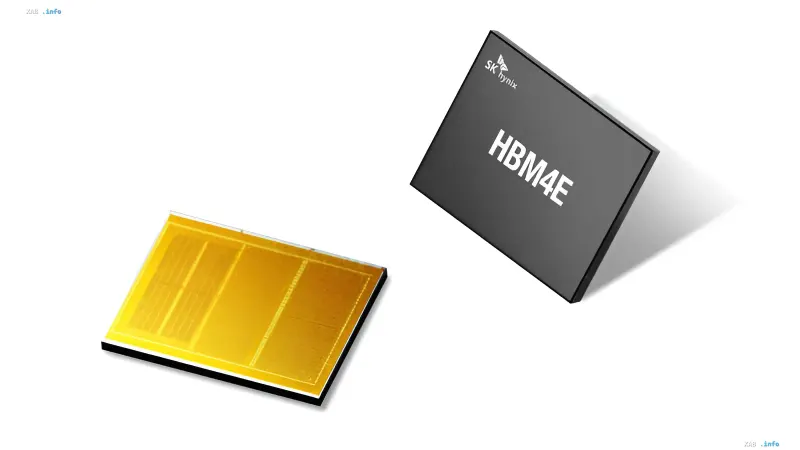
The main driver of this growth is HBM (High Bandwidth Memory) memory, which is critical for the operation of neural networks and data centers. Chips like SK hynix's HBM4E are currently the most scarce and expensive commodity on the market.
Seoul's Reaction and the Investment Question
The South Korean Ministry of Trade, Industry and Energy responded to the rumors cautiously, stating that they "know nothing" about such demands. However, the ministry confirmed its basic position: industrial issues should be resolved based on commercial expediency.
It is important to note the context: Korean companies are already actively investing in the US as part of business roundtables and last year's tariff agreements. SK hynix and Samsung Electronics have announced massive investments in the US economy. However, despite these promises, none of the companies currently intends to build advanced DRAM or NAND chip manufacturing plants on US territory, which are the basis of their profits.
Discussion on "Excess Profits"
The US demand for profit sharing fits into a broader global discourse. In recent months, economists and politicians have discussed how to manage the "excess profits" of tech giants. Questions arise as to whether companies should redistribute super-profits among subcontractors, suppliers, or even direct funds to a public fund, considering that the infrastructure for their work is often built with taxpayer money.
To date, Washington has focused on calls to expand domestic production, but now, it seems, is considering the possibility of direct financial participation in the success of its key partners.