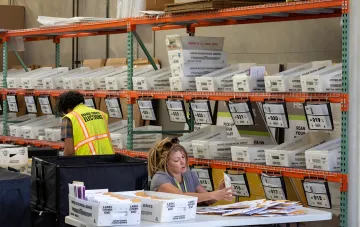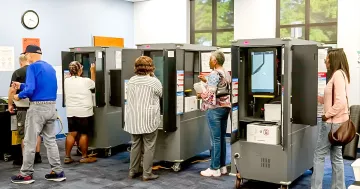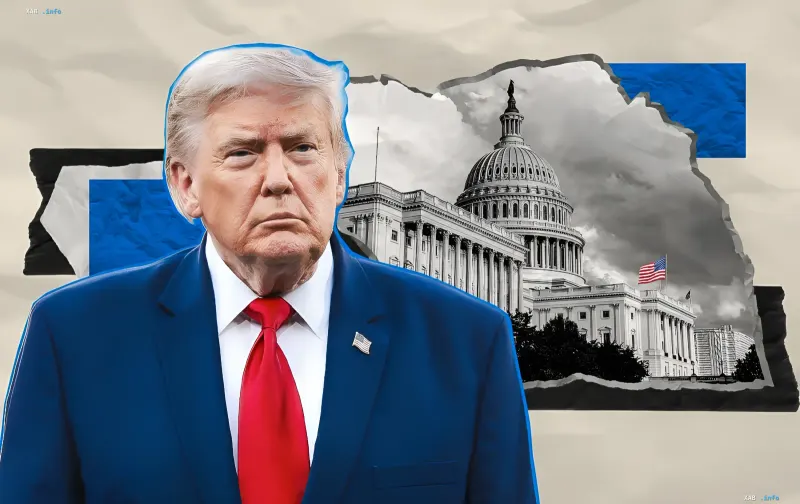
On November 3, the United States is holding midterm congressional elections—a crucial vote that will determine how much power Republicans and Donald Trump personally will lose. The president's name is not on the ballot, but over recent months he has actively toured the country and spoken at rallies, effectively campaigning in support of his party's candidates. At stake is not only the balance of power in the House of Representatives and the Senate, but also Washington's future course on Ukraine, which directly depends on whether Republicans manage to retain control of the legislative branch.
What is at Stake: Congressional Structure and Current Balance
As in any democratic country, the US operates under a separation of powers: the president heads the executive branch, but laws are passed solely by Congress, which distributes the federal budget, oversees the government through hearings and committees, and confirms cabinet appointments. The lower chamber—the House of Representatives—consists of 435 members elected for two-year terms from single-member districts; Republicans currently hold a slim majority of 218 seats to Democrats' 214. The upper chamber—the Senate—has 100 senators (two from each state regardless of population) elected to six-year terms; 35 of them are up for re-election this year. Currently, the Senate features 53 Republicans and 47 senators in the Democratic caucus (45 Democrats and two independents—Bernie Sanders and Angus King). To shift the balance, Democrats need to win at least four seats; in a 50-50 tie, the deciding vote belongs to Vice President JD Vance. Additionally, 35 governors are being elected on this day, whose decisions could prove decisive in the 2028 presidential election.
Why the President's Party Almost Always Loses
American politics has a well-established pattern: in midterm elections, the incumbent president's party loses an average of about 25 seats in the House of Representatives, and this rule has failed only twice in history. This time, voters' habit of maintaining a balance between parties is compounded by Trump's own missteps. The main blow to Republican positions came from soaring fuel prices, which skyrocketed following the outbreak of war with Iran and the closure of the Strait of Hormuz: in September, diesel prices exceeded six dollars per gallon—an all-time high. Since motor transport forms the backbone of US logistics, rising fuel prices automatically pulled up the cost of most goods, undermining the president's key campaign promise. The pledge to end the Russia-Ukraine war "in 24 hours" remained unfulfilled, and inflation continues to break records.
The Diesel Deal and Conflict with Kyiv
Seeking to prevent a rout of his party, Trump leveraged the fuel price issue during the campaign by criticizing Ukraine and pointing to the so-called "diesel deal" with Vladimir Putin—an agreement to purchase millions of tons of Russian diesel fuel. First Lady Melania Trump also de facto joined the campaign, publicly leading a humanitarian initiative in Oleshky. Meanwhile, according to Reuters, the US president has repeatedly linked the rise in energy costs to Ukrainian strikes on Russian oil refineries, while Volodymyr Zelenskyy publicly disagreed with this stance, calling the deal a "gift to Putin." Politico warns that Kyiv's sharp reaction could bring tangible consequences: Washington could suspend intelligence sharing, restrict Starlink, and limit weapons procurements, while Royal United Services Institute expert Tim Willasey-Wilsey calls a "wounded Trump" a real threat to Kyiv.
What Scenarios are Emerging for Ukraine
The election outcome will determine whether the Trump administration can fully advance its foreign policy course. If Republicans retain control of both chambers, the president will retain room for maneuver regarding new agreements with Moscow and pressure on Kyiv, including a potential reduction in intelligence and military support. Should Democrats win back at least some seats and gain control of one of the chambers, oversight committees could limit executive branch authority and slow down any concessions on the Ukrainian issue. For Ukraine, the stability of intelligence-sharing channels and weapons supply lines remains critical, which, according to Western publications, are already under threat amid deteriorating relations between Washington and Kyiv.
Thus, on November 3, Americans are voting not only on the composition of Congress, but also on what the vector of US foreign policy will be over the next two years—and, consequently, the volume of support Kyiv can count on amid the ongoing conflict.