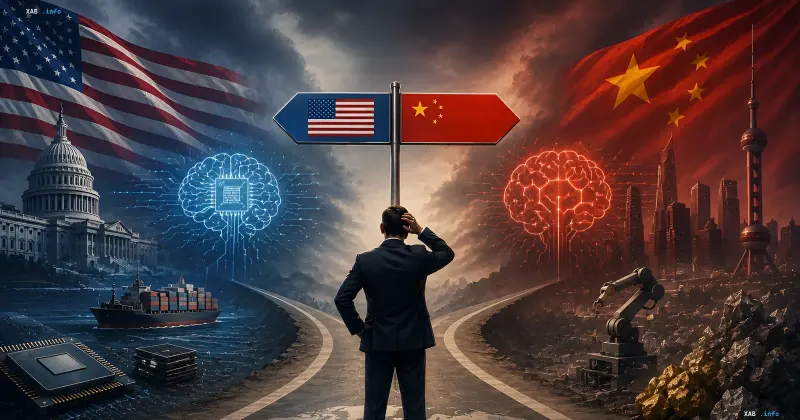
On August 15, 2026, the world witnessed a new escalation in the technological rivalry between superpowers. According to Reuters, Washington has prepared official letters for 35 countries that signed the "Declaration on Artificial Intelligence Capabilities" in June. The documents, obtained by journalists, contain an ultimatum: states must make a conscious choice between the US "Pax Silica" initiative and competing projects that the American administration considers a threat to national security and technological sovereignty.
The "Pax Silica" Ultimatum: Being Part of Everything Means Belonging to Nothing
The essence of the American initiative, launched last year, is the creation of a closed ecosystem integrating semiconductor supply chains, critical minerals, and artificial intelligence models. An internal State Department document draft, which became public, emphasizes that participation in Pax Silica is not just a formal registration but a serious political commitment.
"Being part of everything also means actually belonging to nothing," the letter text states. Washington explicitly declares that Pax Silica obligations cannot be accepted simultaneously with participation in initiatives whose requirements contradict the interests of the United States. Although China is not mentioned directly in the letter, the context clearly points to the World Artificial Intelligence Cooperation Organization (WAICO) created by Beijing.
China's Response: WAICO and the Pursuit of Technological Sovereignty
In response to US pressure, Beijing established WAICO in July 2026, initiated by President Xi Jinping. The organization's goal is to promote global cooperation in AI and popularize Chinese models, which are positioned as more accessible and open to developing countries. While Pax Silica aims to restrict competitors' access to advanced chips and resources, WAICO offers an alternative ecosystem.
The situation is exacerbated by the fact that civilian AI models in China are demonstrating rapid progress, narrowing the gap with proprietary developments by American giants like OpenAI and Anthropic. This makes the technological choice for many countries not just a matter of loyalty, but of economic expediency.
Contradictory Data
There is significant uncertainty regarding the status of the letter distribution. Reuters reports that it was impossible to determine exactly when the US intended to send these messages and whether their content would be changed before final dispatch. Furthermore, the document draft contains subtle nuances: the US justifies its demands by the need for "reliable positioning" in the technological ecosystem, yet critics point out that this could be an attempt to artificially fragment the global AI market.
Particular attention is drawn to the case of Kazakhstan. The country is a member of Pax Silica and is considered an important source of critical minerals, yet it has simultaneously joined the Chinese WAICO. Currently, Kazakhstan is the only known country participating in both organizations, placing it in a difficult diplomatic position in the face of the American ultimatum.
Geography of Choice: From Argentina to South Korea
The list of 35 countries that received the letters is impressive in its diversity and geographical scope. It includes not only traditional US allies such as Japan, South Korea, Australia, and NATO countries (Germany, Italy, France), but also states traditionally striving for neutrality or having close economic ties with Beijing. The list includes Argentina, India, Saudi Arabia (through partners), the UAE, as well as countries in Latin America and Southeast Asia.
US officials state that "you cannot have both at the same time," attempting to isolate China from the resources necessary for the AI arms race. However, given that many of these countries depend on Chinese investment and export markets, forcing a choice could lead to unpredictable geopolitical shifts.