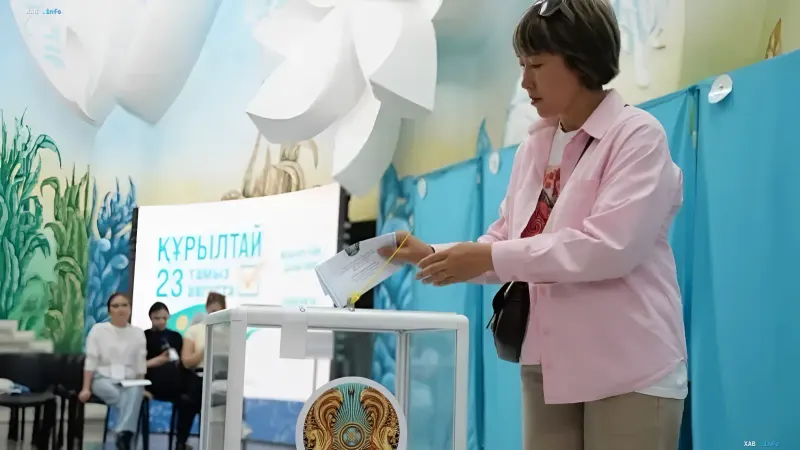
On August 23, 2026, polling stations opened across Kazakhstan, where citizens are casting their votes in the election for the country's new unicameral parliament — the Kurultai. According to the Central Election Commission, voting began at 7:00 a.m. local time. The campaign features 545 candidates nominated by seven political parties, making these elections one of the key political events of the year and the final stage of a constitutional reform that has restructured the entire system of representative power in the country.
A Historic Transition to a Unicameral System
The main innovation defining the nature of these elections is Kazakhstan's new constitution, which came into force on July 1, 2026. The document provides for the creation of a unicameral parliament of 145 deputies elected for a five-year term. This marks a decisive break with the previous model, under which legislative power was bicameral, consisting of a lower chamber — the Mäjilis — and an upper chamber. Thus, voters are casting their ballots for the first time in a fully renewed, simplified, and — by the reformers' design — more efficient legislative body.
The Scale of Voting
The organizational infrastructure of the elections covers the entire territory of the country: 10,423 polling stations have been set up nationwide, with more than 12.6 million voters registered. This scale makes Kurultai-2026 one of the largest single-day votes in Kazakhstan's recent history and requires substantial logistical and administrative preparation at the local level, from opening the stations at 7:00 a.m. to counting the votes at the end of the day.
Assessment by International Observers
The course of the elections has attracted the attention of foreign diplomats and international organizations. The head of the Turkic Council (TürkPA) mission called the Kurultai elections a historic event for the country, while a number of foreign diplomats, assessing the process, stated that Kazakhstan is showing the world how democracy works. These assessments reflect the foreign-policy accompaniment of the reform and an attempt to present the new parliamentary format as an element of modernizing the political system.
Contradictory Data
In publications devoted to election day, there is an inconsistency in which specific snapshot of the process they reflect. Some materials record the opening of polling stations and the start of voting at 7:00 a.m. as the main event of August 23. At the same time, certain sources already report a turnout exceeding 65%, which is characteristic not of the moment of opening but of an intermediate or final stage of the count. The discrepancy is probably explained by different publication and data-update timeframes; however, for the reader this means that the turnout figures and the fact of the "start of voting" refer to different points in the same day and should not be considered mutually exclusive.