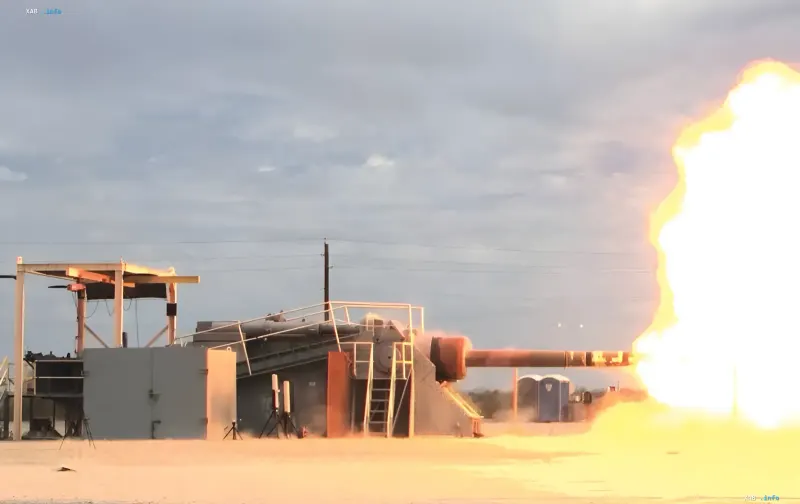
On July 30, 2026, an event occurred at the Yuma Proving Ground in Arizona that could radically change the approach to hypersonic weapon development. The U.S. Army conducted the first full-scale test of a hypersonic warhead launched not by a rocket, but from a large-caliber cannon.
The operation was carried out jointly by specialists from the Yuma Proving Ground, the DEVCOM Armament Center, and Lawrence Livermore National Laboratory. The Heavy Artillery Test System (HATS), based on the defunct Strategic Long Range Cannon (SLRC) program, was used for the shot.
The "Cannon" Launch Technology
The SLRC program once envisioned creating a mobile cannon capable of striking targets at distances exceeding 1,600 km. Although the project was closed, its developments found new application. The HATS system allows accelerating a warhead to hypersonic speeds without using a rocket engine.
The main goal of this method is to test the vulnerability and functionality of the warhead upon impact with a target. Engineers focused on key questions: does the warhead structure withstand extreme loads, does the detonator function, and is the integrity of the payload preserved upon impact?
To protect sensitive components from overloads exceeding those experienced by the warhead in actual flight, a special Integrated Launch Package was developed. It includes a pallet, an electronic fuze, and telemetry sensors.
Economic Efficiency
The key advantage of the cannon method is cost and speed. A full flight test of a hypersonic missile requires launch vehicles, engines, guidance systems, and complex range support, costing millions of dollars per launch.
At the same time, a cannon allows for significantly more shots within the same budget. This gives engineers the opportunity to gather more data for calibrating computer models and accelerating the development of new hypersonic munitions.
Limitations of the Method
It is important to understand that a cannon shot does not reproduce the operation of a cruise engine, hypersonic flight, or missile maneuvering. Full-scale flight tests remain necessary to verify these critical characteristics.
However, the cannon method allows separating expensive and complex engine and guidance system tests from the cheaper testing of the warhead. This creates a new paradigm in hypersonic weapon testing.
International Context
Tests in the USA are taking place against the backdrop of active hypersonic system development by other countries. It was previously reported that Germany and Britain are secretly developing a new DPS missile, among the variants of which a hypersonic version with a speed at least five times that of sound is being considered.
It has also become known that the USA is expanding the production of Patriot and THAAD interceptor missiles, signing a contract with Lockheed Martin and Northrop Grumman for more than $3 billion — against the backdrop of stock reductions due to the war in Ukraine and the conflict in the Middle East.
Significance for the Future
The successful conduct of tests at the Yuma Proving Ground opens new opportunities for accelerated hypersonic weapon development. The cannon launch method allows for more tests, more data collection, and faster warhead refinement, which could significantly impact the arms race in the coming years.