YouTube creator Bitluni, known for his low-level electronics experiments, has returned to an idea he previously pursued: building a VGA graphics card powered solely by a small microcontroller. This time, the goal was clearly defined: make the device even more compact than the previous project. The result is a miniature printed circuit board capable of outputting a monochrome image, with the total component cost of a single such "graphics card" amounting to roughly 20 cents. The project demonstrates how far video signal generation can be pushed when the developer has only a single chip without a dedicated graphics block.
Why CH570 Instead of RISC-V
In a previous experiment, Bitluni used the CH32V003 microcontroller based on the RISC-V architecture, but its capabilities proved insufficient for the tasks at hand. For the new project, the enthusiast chose the CH570 chip, which offers a larger amount of RAM as well as built-in USB and Bluetooth interfaces. These specific features made both video signal generation and subsequent data transmission via the USB CDC serial interface possible; without them, the project would have remained nothing more than a static test.
PWM Instead of DAC: How the Image is Born
To generate the video signal, the blogger used Pulse-Width Modulation (PWM), turning it into a makeshift Digital-to-Analog Converter (DAC). A conventional DAC converts digital data into an analog signal with specific voltage levels, whereas the CH570 lacks such a block. It is simulated using PWM: the microcontroller rapidly switches the signal between on and off states, and changing the pulse duration approximates the voltage. The principle is analogous to that used in modern Class-D amplifiers. Bitluni limited himself to 16 shades of gray, which determined the monochrome nature of the output.
Memory as the Main Bottleneck
The microcontroller has quite limited RAM, making it impossible to store a full image frame in it. At first, the blogger decided to output text with vertically halved resolution, but image generation ran extremely slowly. The problem was solved when he moved the executable code into the microcontroller's SRAM cache. This sped up image generation by 24 times and allowed text output in a 34×37 character format—already a quite readable buffer for demonstrating the device's operation.
From Text to Rick Astley
After stabilizing the text output, Bitluni moved on to graphics. Following additional optimizations, he managed to render a dancing Rick Astley on screen—a traditional test for projects of this kind. The animation consisted of just a few low-resolution frames, yet it recognizably conveyed the singer's movements. For a device running on a single microcontroller without a graphics coprocessor, this served as clear proof that even a task as complex for a chip as rendered output is achievable with clever code optimization.
Circuit Board, USB, and an Accidental Antenna
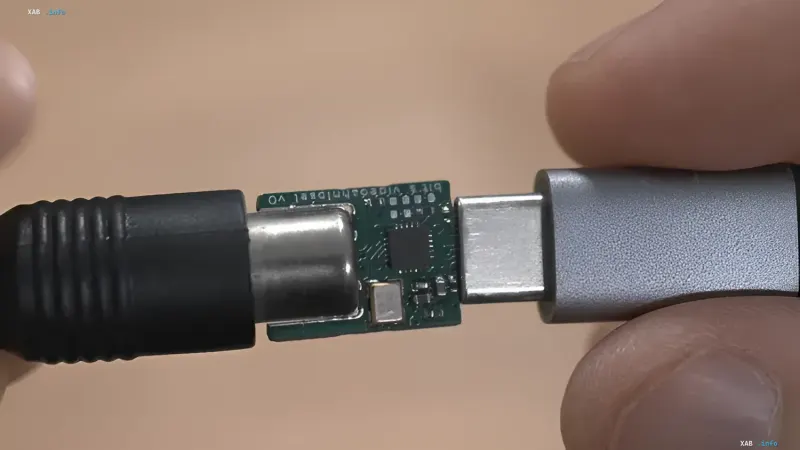
During the development stage, the microcontroller was connected to a small CRT television via a composite video input. Then the blogger manufactured a custom printed circuit board, placing the CH570, a USB-C connector, and a few additional components on it. He paid 15 dollars for a batch of ten boards, while the components for a single finished "graphics card" cost about 20 cents; the microcontroller itself cost 13 cents. Even the homemade RCA connector turned out extremely simple—the board was designed with just a couple of special cutouts for it. The final step was connecting USB for data transfer via the USB CDC serial interface: USB processing fell on the microcontroller's processor and consumed time needed for video signal generation, but after several optimizations, the television began displaying text typed from a computer. A funny finale was that a jumper wire on the development board unexpectedly acted like a VHF antenna, nearly allowing him to catch a television broadcast on this setup.