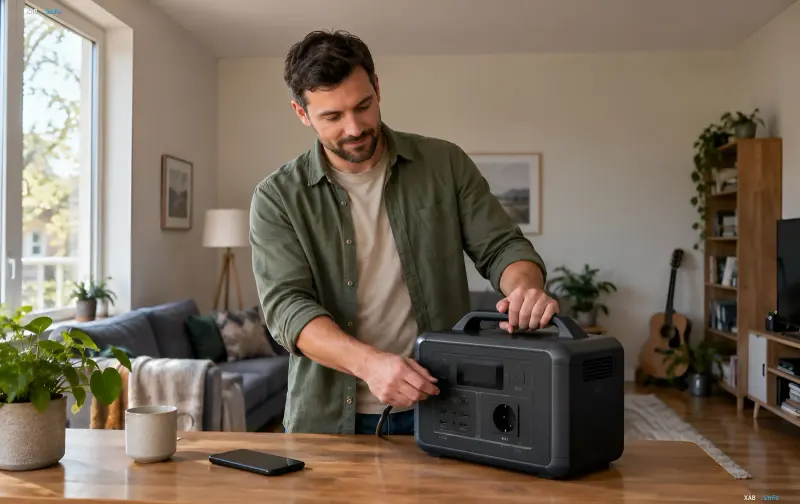
A portable power station can lose charge even when nothing is plugged into its outlets. This is not always a sign of a malfunction: a significant portion of energy is consumed by the device's own components—the inverter, internal electronics, and communication modules. Before contacting customer service, you should check the active outputs and station settings to understand exactly where the energy is going.
The Inverter and AC Outlet 'Background' Drain
The inverter is responsible for operating the standard AC outlets. It converts the battery's direct current (DC) into the alternating current (AC) needed for household appliances, and it can consume energy even without connected devices. As a reference point, manufacturer Jackery cites standby inverter consumption at around 12 watts. Over eight hours of continuous operation, this amounts to about 96 Wh—roughly one-fifth of a 500 Wh station's nominal capacity. This is a conditional example: actual losses depend on the specific model and settings.
Turning Off the Screen Is Not Turning Off the Unit
The station's display may automatically turn off to save energy, but the station itself remains on, and its internal electronics continue to work. Blanking the screen or turning off the outlets does not mean the device is powered down. In addition, some models can be turned on via an app or remote control, and simply waiting for such a command also requires energy. For instance, the EcoFlow DELTA Pro manual states that Bluetooth standby mode consumes power even after the station is turned off using the main power button.
Self-Discharge During Storage
Even when the station is completely turned off, the battery loses a portion of its charge over time—this is a physical property of energy storage devices. One manufacturer points to losses in the range of 1–3% per month. It is important to understand that this is a characteristic of a specific model, not a universal norm for all stations; the rate of self-discharge is affected by battery health and storage conditions.
How to Check the Source of Losses and When Service Is Needed
If the station is used as backup power, you should first check how its automatic shutdown works: some models turn off the output under low or zero load, which can interrupt power to a router or a refrigerator whose compressor runs intermittently. To determine if the losses are related to active functions, two operating modes are compared—the check is performed during the day while at home, without leaving the powered station unattended. If the losses are noticeably smaller after shutdown, active components were likely the cause; such a check only helps orient yourself and does not replace diagnostics, and a small difference in readings by itself does not prove a malfunction. There is no universal norm for overnight charge loss.
You should contact manufacturer support if the station behaves abnormally. In case of casing deformation, a burning smell, or excessive heating, you must stop use and charging and not attempt to disassemble the device yourself. The SES (State Emergency Service) also reminds users not to operate a station with a damaged casing, charging ports, or outlets. If the station smokes or catches fire, you must evacuate the room and call emergency services at 101.