Literary adaptations have long ceased to be the sole prerogative of cinema. Video games have evolved into a full-fledged medium that allows not just retelling a book's plot, but immersing the reader into its universe from within. Developers transport familiar characters into interactive adventures, let players explore worlds invented by writers, and even allow them to change the course of events that were predetermined by the author in the original text. Styler editor Yulia Lyushneva has compiled a selection of five video games based on famous books — ranging from grand fantasy to unusual psychological stories.
The Witcher: When Choice Matters More Than a Sword
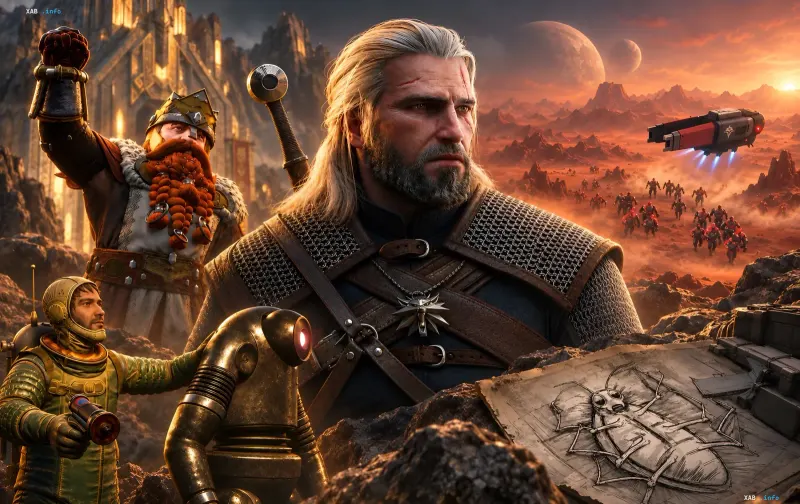
The Witcher 3: Wild Hunt is an RPG by the Polish studio CD Projekt Red, based on Andrzej Sapkowski's book series. The protagonist, monster hunter Geralt of Rivia, travels across war-torn lands in search of his adopted daughter Ciri, who is hunted by the mysterious Wild Hunt, capable of posing a threat to the entire world. Players are treated to a massive open world featuring medieval cities, swamps, snow-covered islands, and settlements where every conversation can hide a unique story. Here you can take on monster contracts, explore ancient ruins, brew potions, and engage in political intrigue.
The defining feature of The Witcher 3 is that the game does not retell Sapkowski's books, but offers a new story featuring familiar characters. According to Styler's editors, this approach allows players to better feel the contradictions of the Witcher's world: even a noble deed can have unexpected consequences, and the choice between good and evil often turns out to be more complicated than it seems at first. Instead of observing Geralt's decisions on the pages of a novel, the player is forced to make them and influence the plot firsthand.
Moria After Sauron: Reconstruction Instead of Saving the World
The Lord of the Rings: Return to Moria is a survival adventure game by Free Range Games, set in J.R.R. Tolkien's literary universe. The events take place after the conclusion of The Lord of the Rings story, when the dwarves decide to reclaim their ancient underground kingdom of Moria. Summoned by Gimli, the player ventures into a vast labyrinth of underground halls, abandoned mines, and ruined settlements where they must gather resources, craft equipment, restore ancientforges, and build their own bases. The dungeons hide various dangers — from hunger and exhaustion to attacks by orcs and other creatures. Moria can be explored solo or with friends.
The uniqueness of Return to Moria lies in the fact that it shows Middle-earth not during the Great War, but after the victory over Sauron. Instead of saving the world, the player gradually brings life back to a place that remained abandoned for centuries. As Styler's editorial team notes, the idea of restoring the dwarven kingdom — where once-majestic halls fill with light again and ancient forges start working — allows players to see Tolkien's familiar world from a different perspective: through the lens of rebuilding what was lost.
Dune: The Power of Spice and Sandworms
Dune: Spice Wars is a sci-fi 4X strategy game by Shiro Games, based on Frank Herbert's novel Dune. The events unfold on the desert planet Arrakis, where several powerful factions fight for control over spice — a unique resource that dictates the economy and political influence across the known universe. The player must lead one of the factions, develop settlements, organize spice harvesting, expand territories, spy on rivals, and decide when to deploy military force. A separate threat comes from giant sandworms, which react to movement in the desert and destroy careless units or equipment.
Unlike many games based on sci-fi books, Dune: Spice Wars does not focus on the exploits of a single hero. It lets you manage an entire political force upon whose decisions the future of Arrakis depends. One of Herbert's core ideas is strongly felt here: true power does not always belong to the one with the strongest army. Sometimes a well-crafted alliance or resource control can change the situation much faster than a massive battle.
Lem's The Invincible: Astrobiology and Lost Memories
The Invincible is a sci-fi narrative adventure game by the Polish studio Starward Industries, based on Stanisław Lem's novel The Invincible. The protagonist is astrobiologist Yasna, who wakes up on the mysterious planet Regis III. Upon waking, she discovers that some of her memories are missing and her fellow research crew members have vanished without a trace. The game immerses the player in the atmosphere of Lem's classic hard sci-fi, where scientific inquiry clashes with existential uncertainty and the boundary between human and alien worlds blurs.
Why Book Adaptations Continue to Work
Styler's selection demonstrates that a successful adaptation of a book into a game goes far beyond a mechanical transfer of the plot. Each of the featured games chooses its own angle: The Witcher 3 gives players the authorship of choices, Return to Moria shifts the focus from an epic conflict to the daily grind of reconstruction, Dune: Spice Wars turns a philosophical parable into a strategic simulation of power, and The Invincible preserves the psychological depth of Lem's prose. This diverse approach is precisely what allows literary universes to live on in an interactive format rather than simply repeating what the reader already knows from the pages.