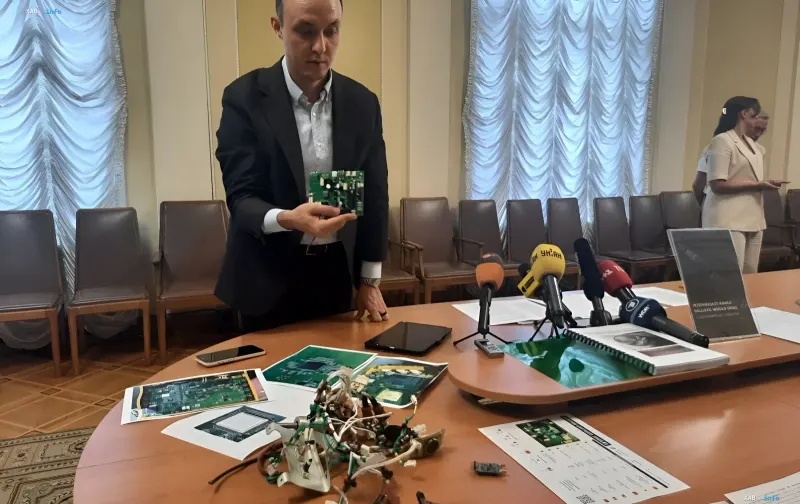
Adviser to the President of Ukraine on sanctions policy, Vladislav Vlasjuk, held a briefing dedicated to the technical analysis of the Russian medium-range ballistic missile (MRBM) «Oreshnik». The expert demonstrated fragments of the missile to journalists and stated that there are practically no foreign components left in its design.
Belarusian chips instead of Western ones
During the presentation, Vlasjuk showed debris from the «Oreshnik» and the «Banderyol» cruise missile. According to him, an analysis of the electronics revealed that out of thousands of components making up the missile, more than 1,000 were produced in Russia. Another approximately 100 elements are of Belarusian origin.
«The main part was manufactured in 2023–24, there is 2025. That is, they are producing some of their own things right now», — noted the adviser. This indicates that Russian industry is already capable of producing such combat systems practically without using components from abroad.
Tungsten kinetic charge
Special attention at the briefing was paid to the warhead. Vlasjuk demonstrated what the kinetic charge looks like approximately. According to his data, it contains 36 war elements, which are likely made of tungsten.
Accuracy and information pressure
Earlier, it was reported that «Oreshnik» missiles could deviate from the target by tens of kilometers. This problem, according to experts, is related to possible malfunctions in the guidance systems. The Institute for the Study of War (ISW) noted that threats of new strikes using «Oreshnik» could be an element of information pressure from the Kremlin.
Test site in Kapustin Yar
Launches of «Oreshnik» are carried out from the «Kapustin Yar» test site, located near Kazakhstan. The territory is 1100 km from Kyiv. The city located near the test site lives in poverty, ruin, and filth.