
As of September 2026, a full picture of the admissions campaign to vocational education institutions has taken shape in Ukraine. According to RBC-Ukraine, citing a publication by the press service of the Ministry of Education and Science (MES), 74,112 applicants are beginning vocational education this year, and a total of 513 such institutions operate across the country. Applicants have submitted a combined 97,431 admission applications, indicating sustained demand for short applied training programs. In the words of Deputy Minister of Education and Science of Ukraine for Digital Development, Digital Transformations and Digitalization Dmytro Zavhorodniy, vocational education "can give students a clear path from training to their first job."
Scale of the campaign: nearly 98,000 applications
The key indicator of the season is the ratio of applications submitted to actual admissions. Of the 97,431 applications submitted, 74,112 people begin their studies, meaning that roughly three-quarters of all applications are converted into admissions. The MES notes that the highest demand is for training programs in a number of in-demand professional qualifications, which the ministry identifies as priorities for the labor market. The concentration of applications on a limited set of specialties reflects business demand for applied personnel and shapes the "trending" directions of colleges.
Free education as the norm, not the exception
A significant share of new students will study without paying: according to MES data, 72,524 of the 74,112 applicants are pursuing vocational education for free. For certain categories of citizens, additional free training is available via a voucher worth around 33,000 hryvnias. The structure of admitted students is also telling: nearly 69% of applicants were admitted after the 9th grade, meaning that vocational college remains the main continuation of education for a significant share of basic school graduates. This underscores the role of vocational education as a mass, rather than elite, track.
The path from the workshop to the first job
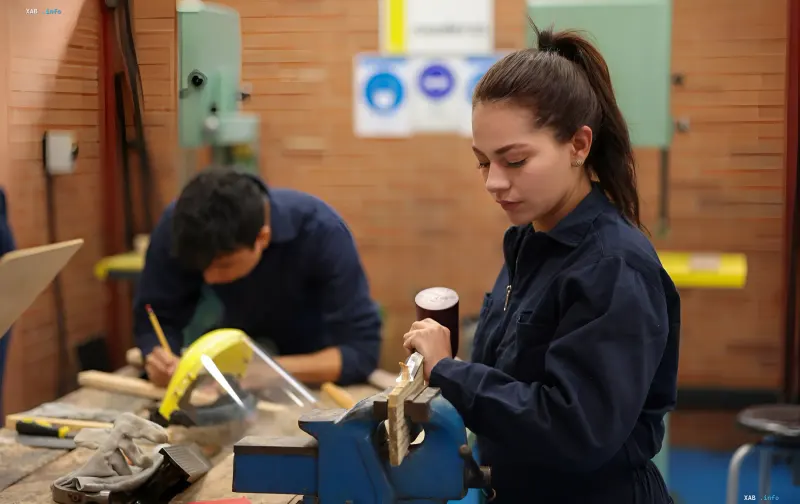
The MES emphasizes that to turn training into real employment, the ministry is upgrading workshops, changing the content of education, and strengthening cooperation between colleges and business. It is precisely the practical, "workshop" component — working on machines, in workshops and laboratories — that is seen as the link between study and the first job position. Prospective students are offered a specialized platform for choosing an educational institution, where detailed information, answers to frequently asked questions about admissions for both schoolchildren and adults, and descriptions of current professions in Ukrainian colleges are gathered.
Contradictory data
When comparing figures from different publications, a discrepancy arises in assessing the share of free education. In the basic MES message (via RBC-Ukraine), 72,524 of the 74,112 applicants study for free, which amounts to around 98%. At the same time, the headline of a separate RBC-Ukraine article features the wording "90% study on the state budget." These indicators probably reflect different slices: "free" includes all forms of tuition-free training, whereas "on the state budget" refers only to the targeted state-budget quota, which is a subset. Nevertheless, the exact ratio of these categories is not unambiguously disclosed in open data, and readers should bear in mind that the percentages in headlines and in the statistics may refer to different bases.
Context: the vocational education law and early career guidance
The current campaign is taking place against the backdrop of systemic changes: last year the Verkhovna Rada adopted a law on vocational education, which, according to the ministry's assessment, brings "fundamental changes to vocational-technical education." In parallel, early career guidance is being introduced in Ukrainian schools, and an information platform for choosing a college is operating for applicants. Taken together, these measures are aimed at making the path from the school bench or adult retraining to the first job in one's specialty transparent and as accessible as possible, including free and voucher forms of education.