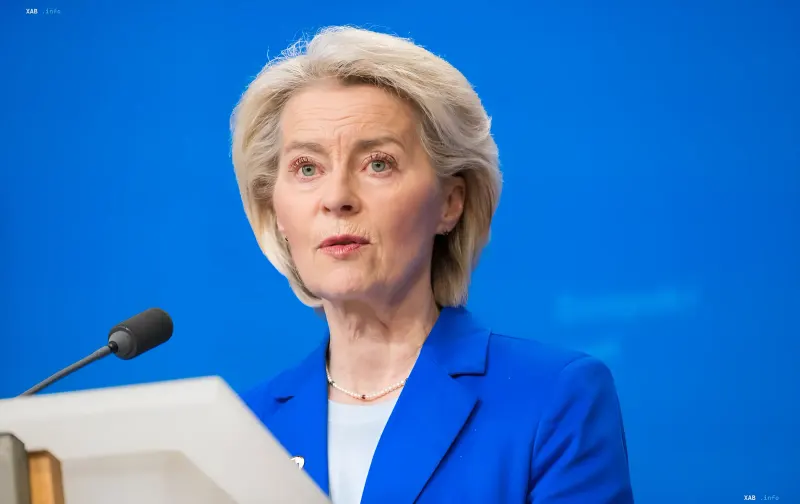
European Commission President Ursula von der Leyen, following a telephone conversation with Finnish President Alexander Stubb, announced that Europe will take part in the peace talks between Ukraine and Russia in the E5+EU format. She reported this on her X social media account, as cited by RBC-Ukraine. According to the head of the European Commission, Brussels will provide Ukraine with 'maximum support' and simultaneously apply 'maximum pressure' on Russia throughout the negotiation process.
The E5+EU Format: How Europe Will Enter the Negotiation Process
Von der Leyen and Stubb discussed the prospects for a peaceful settlement of the conflict. The European Commission President emphasized that Europe will 'closely join' the negotiation process precisely in the E5+EU format, meaning with the participation of the continent's five largest economies—the UK, France, Germany, Italy, and Spain—alongside the direct participation of European Union institutions. This format implies that the European side will be represented not by a single diplomat, but by a coalition of key states, which, according to Brussels' design, should ensure a negotiating weight comparable to Moscow's position. Von der Leyen also thanked Finland for its efforts to end the war, noting Helsinki's role in coordinating the European position.
Three Directions of Support for Ukraine Ahead of Winter
In parallel with the announcement of the negotiation format, von der Leyen outlined three concrete directions of support for Ukraine for the near future. The first is large-scale humanitarian and energy assistance during the winter period: the EU, together with international partners, will help Ukraine strengthen its power supply and heating systems. The second is the accelerated strengthening of air and missile defense: according to Interfax-Ukraine, the EU has already approved the procurement of American interceptor missiles for Patriot systems, which are to be delivered to Ukraine in the shortest possible time, while Brussels intends to reduce dependence on a single air defense supplier. The third direction is tightening control over compliance with the sanctions regime against Russia.
Context: Results of Trilateral Talks in Abu Dhabi
The issue of Europe's participation in the peace process escalated after trilateral talks in Abu Dhabi, which involved representatives from Ukraine, Russia, and the United States. According to RBC-Ukraine sources, the meetings concluded with an agreement on a prisoner exchange, but the Russian side refused to discuss key issues: a ceasefire, territorial claims, energy, and security in the Black Sea. It was precisely after these talks that Ukrainian President Volodymyr Zelensky publicly urged European capitals to determine their representative for the talks by the end of November, emphasizing that Europe must participate in the settlement 'on equal terms' rather than as an observer.
EU Enlargement and the Question of the European Representative
Separately, von der Leyen and Stubb discussed European Union enlargement on the eve of the EU Enlargement Forum, scheduled for November 16. The parties agreed that 'a larger and stronger Union will make Europe richer and more independent.' Against this background, proposals for new partnership formats are also being voiced in Brussels: according to Dilo, von der Leyen made a proposal to Canada regarding the status of the first associated EU member, which could become a precedent for expanding the circle of countries integrated into the European security and economic architecture.
Pressure on Russia and Review of the Security System
In addition to the negotiation track, von der Leyen in a recent speech called for a 'cardinal overhaul' of the EU security system, emphasizing that European states 'must clearly understand' the scale of threats. The statement came against the backdrop of ongoing Russian attacks on Ukrainian infrastructure and in the context of preparations for a difficult heating season. Thus, Brussels is building a two-vector strategy: on the one hand, readiness for negotiations in the E5+EU format; on the other hand, consistent strengthening of sanctions pressure and military support for Ukraine until a sustainable settlement is achieved.