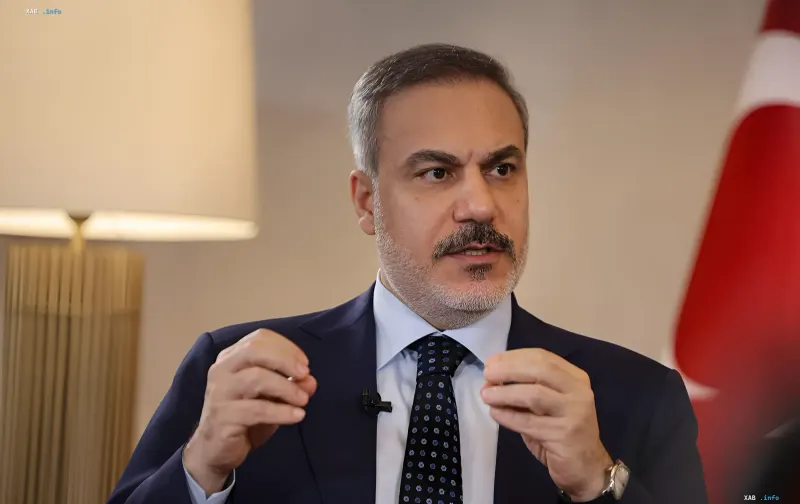
Turkish Foreign Minister Hakan Fidan stated in a comment to TRT Haber that Moscow is not interested in concluding a temporary Black Sea agreement unless it is linked to a long-term peace settlement between Russia and Ukraine. According to the Turkish diplomat, this exact stance by the Russian side is the main brake on achieving even a partial cessation of hostilities in the region. Fidan emphasized that Ankara has its own ideas on creating a basis for mutual understanding between the parties, though he added that «it is still too early to share them with the public».
Donbas as the Central Obstacle
The Turkish Foreign Minister directly pointed out that the entire essence of the problem regarding a truce in the Black Sea and, more broadly, ending the war boils down to the status of Donbas. «Russia demands that it be given up, while Ukraine says it will not do this,» Fidan stated. According to him, this very issue is the reason for the continuation of hostilities. At the same time, the minister cited two different assessments of the scale of the territorial dispute: according to Russian calculations, it concerns the remaining 11–12% of the territory, whereas according to Ukrainian estimates, it is 18%.
Ceasefire Line and Security Guarantees
Fidan explained that after a peace agreement is concluded between Kyiv and Moscow, it will be necessary to seriously work out where exactly the ceasefire line will run. Only after that, he said, can discussions move on to security guarantees and the overall security architecture in Europe. «Peace between Ukraine and Russia will be peace not only between these two countries. It will also be peace between Europe and Russia,» the Turkish Foreign Minister stressed, adding that Ankara holds «very serious considerations» regarding the new security architecture on the continent.
Context: Energy Truce and Sanctions
Fidan's statements came amid ongoing discussions about a potential sectoral truce. Earlier, according to American and Ukrainian officials briefed on the talks, Moscow demanded the lifting or easing of U.S. sanctions in exchange for approving a truce in the energy sector, while simultaneously trying to tie this initiative to a Black Sea truce. Publicly, however, the Russian side has shown no readiness for such agreements: Kremlin Spokesperson Dmitry Peskov stated on October 8 that Moscow «sees no point» in talks on a sectoral truce, calling the energy sector Ukraine's «Achilles' heel». Thus, the position voiced by Fidan — linking any partial agreement to a comprehensive peace — aligns with the Kremlin's public rhetoric.
What's Next: The Complexity of a Multilateral Deal
Fidan acknowledged that reaching an agreement on all issues in a way that suits all parties is «quite difficult». According to him, the content of the discussed agreement includes a whole range of points — from the demarcation line to security guarantees and the architecture of peace in Europe. «While this work is ongoing, we are also dealing with other issues. Perhaps everything will work out, and I hope it will. After all, it is important to achieve a final end to the war,» the Turkish Foreign Minister summarized. Fidan's statement, broadcast via TRT Haber and quoted by RBC-Ukraine, became one of the most detailed public assessments of the peace process by Turkish diplomacy in recent times.