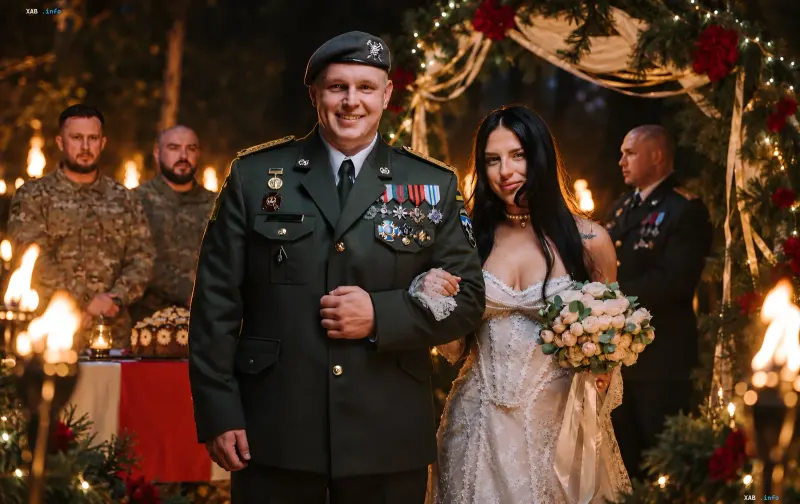
The commander of the 10th Separate Mountain Assault Brigade 'Edelweiss', call sign Dok, and his chosen one Anna got married according to a special military rite called 'Bonding of Fate and Kinship'. The ceremony, which took place outdoors in the evening, combined elements of Ukrainian ritual heritage, military ceremonial, and the traditions of a specific unit. The newlyweds exchanged rings, placed their hands on a sword, and walked through a corridor of torches formed by their fellow servicemen. The rite was conducted by Brigadier General Andriy Biletsky, who concluded by binding the couple's hands with a rushnyk (traditional embroidered towel) and addressing them with the words: 'I wish you sincere love for a lifetime and to create in your small family a reflection of our nation as a great family.'
Where the Rite Came From and Who Developed It
'Bonding of Fate and Kinship' is a modern military wedding ritual developed by the Khorunzhiy (Standard-Bearer) Service of the 3rd Separate Assault Brigade of the Third Army Corps. According to the authors' design, starting a family becomes a significant event not only for the newlyweds themselves, but for the entire military community: fellow servicemen participate in the ceremony, thereby witnessing the beginning of the couple's shared life. The rite combines three layers — traditional Ukrainian ritual heritage, formal military ceremonial, and the internal traditions of a specific unit, making it both universal and personalized.
Symbolism of Each Element of the Ritual
Every gesture in the ceremony carries a specific meaning. Before the rite begins, the newlyweds hand over their weapons to their comrades with the words: 'My life now belongs not only to me.' This gesture symbolizes new responsibility: the serviceman retains his duty to the country, but now also bears responsibility for the person beside him. The sword in the ritual acts as a symbolic witness of the vow — it embodies honor, fidelity to one's word, and readiness to protect. Wedding rings signify loyalty and a shared path, while the towel with which the commander binds the couple's hands signifies unity. By saying 'These hands are now one fate', the commander thus recognizes the new family on behalf of the military community.
The Corridor of Torches: Two Passes and Their Meaning
One of the most visually expressive elements of the ceremony is the newlyweds' walk through a corridor of torches formed by fellow servicemen. The first pass, made at the beginning of the rite, symbolizes two separate individuals who are not yet united. The final pass, by contrast, represents the newly formed family. Thus, the physical space of the ritual becomes a space of transformation: from two individuals to a single union cemented by both civil and military vows.
The Idea of Kinship and Continuation of Life in Wartime
The authors of the rite embed in it the idea of the continuation of life and kinship despite the war. The concept of 'kin' (rod) in this context is connected to the memory of previous generations, care for loved ones, and responsibility to future ones. A wedding in this interpretation ceases to be an exclusively personal event and turns into an act of cultural continuity: a serviceman, by starting a family, simultaneously affirms the continuity of his lineage and nation. It is precisely this idea — 'a reflection of the nation as a great family' in each specific couple — that became the key thought of Brigadier General Biletsky's address to the newlyweds.