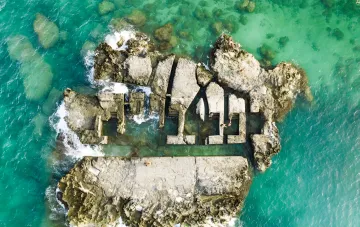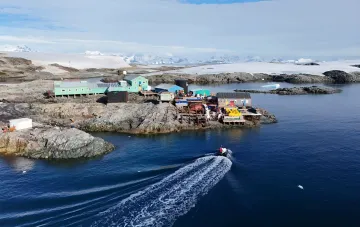
Satellite maps have long ceased to be just a navigation tool: when zoomed in, they turn into a catalog of places that look almost unreal. From geometric patterns in deserts to time-frozen wreckage of machinery — these locations attract the attention of researchers and aerial photography enthusiasts. Below are several such objects that are clearly visible on satellite and aerial images.
The Geometry of the Gobi Desert
In China's Gobi Desert, satellite images clearly show huge geometric structures: white lines and zigzag patterns. They have given rise to numerous theories — from secret military tests to conspiracy theories about signals from extraterrestrial civilizations. At the same time, the structures themselves are indeed connected to space observation technologies, however calling a specific zigzag pattern a proven "target for spy satellites" would be an overstatement. It is precisely this boundary between mystery and real technology that makes the Gobi one of the most interesting objects for studying satellite imagery.
A Time Capsule in the Arctic
On Ellesmere Island in the Canadian territory of Nunavut, the crash site of a Douglas C-47 Skytrain cargo plane has been preserved, frozen in time since 1949. On October 9, 1949, a U.S. Air Force aircraft attempted to take off from a dirt runway at the station during a snowfall, in fog, with ice on the wings and the cockpit windshield, which led to an emergency landing of the overloaded plane. All ten people on board — six crew members and four civilian passengers — survived; three were injured. The cold, dry conditions and isolation preserved the aircraft from destruction, turning it into a time capsule of mid-20th-century aviation.
A Compass in the Heart of the Sahara
In the middle of the Ténéré Desert in Niger lies a stone circle about 18–20 meters in diameter, around which smaller arrow-shaped markers are positioned at a distance. From above, the structure resembles a huge compass lost in one of the most uninhabited regions of the Sahara. For decades the object has attracted travelers, photographers and desert researchers, and its remoteness and geometric shape have given rise to theories about a prehistoric ritual site or a navigational marker. However, there is no evidence of a prehistoric origin for the circle.
A Pond Shaped Like a Human
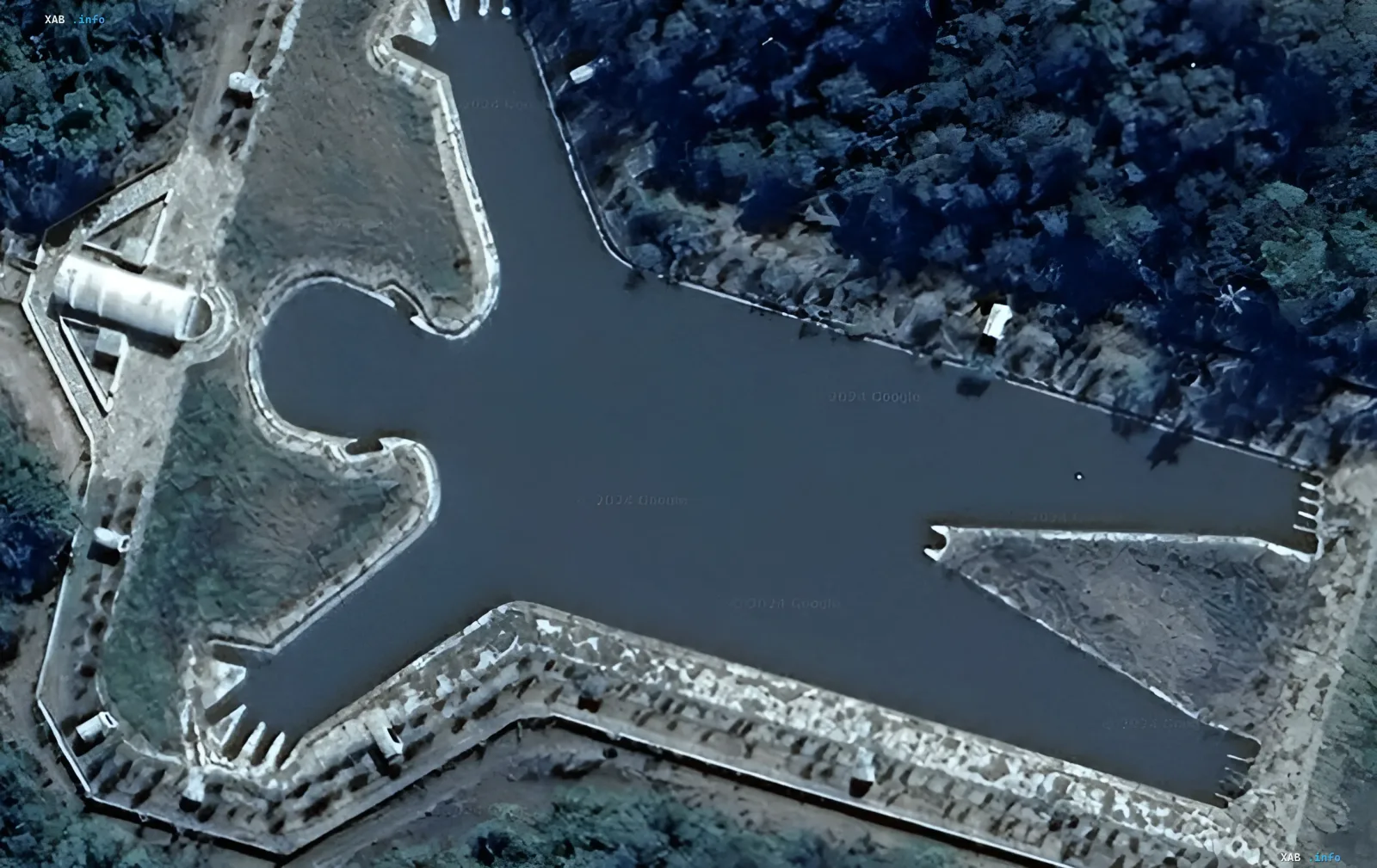
Near Iacanga in the state of São Paulo (Brazil) lies Lagoa Humanóide — a pond that from above resembles a huge human figure with a head, torso, arms and legs. This is not a natural formation, but an artificial pond on private land, created in the shape of a human body. Its unusual shape is clearly visible on aerial and satellite images, however the history of the pond's creation remains largely unknown to this day.
A Volcano, Geoglyphs and an Antarctic Station
In Marie Byrd Land (West Antarctica) there is Mount Takahē — one of the youngest volcanoes on the continent: a shield volcano about 3,460 m high and roughly 30 km in diameter with an impressive caldera. About 8,000 years ago it experienced a powerful explosive eruption, the ash of which has been found in Antarctic ice cores at a considerable distance from the volcano. In the Colorado Desert (California) near the town of Blythe are the Blythe Intaglios — geoglyphs with figures of people and animals, created by indigenous peoples; the largest human figure reaches about 52 m, and its age is estimated at roughly 450–2000 years. Finally, among the uninhabited snowfields of Antarctica, the Conen station stands out with a row of identical structures about 50 m long, built with precise alignment over a stretch of more than a kilometer.
Contradictory Data
For a number of objects, the versions of the parties involved and popular interpretations diverge. In the case of the Gobi, some sources and conspiracy theories claim that the zigzag patterns are "targets" or installations for satellite observation, whereas only the general connection of the structures to space observation technologies has been confirmed, without evidence of a specific military purpose. Regarding the stone circle in Niger, some researchers lean toward a prehistoric ritual origin, while others point out that there is no evidence of such an age. As for Lagoa Humanóide, its artificial origin is obvious, but the history of the pond's creation is not disclosed in open sources. These inconsistencies are important to consider when interpreting the images.