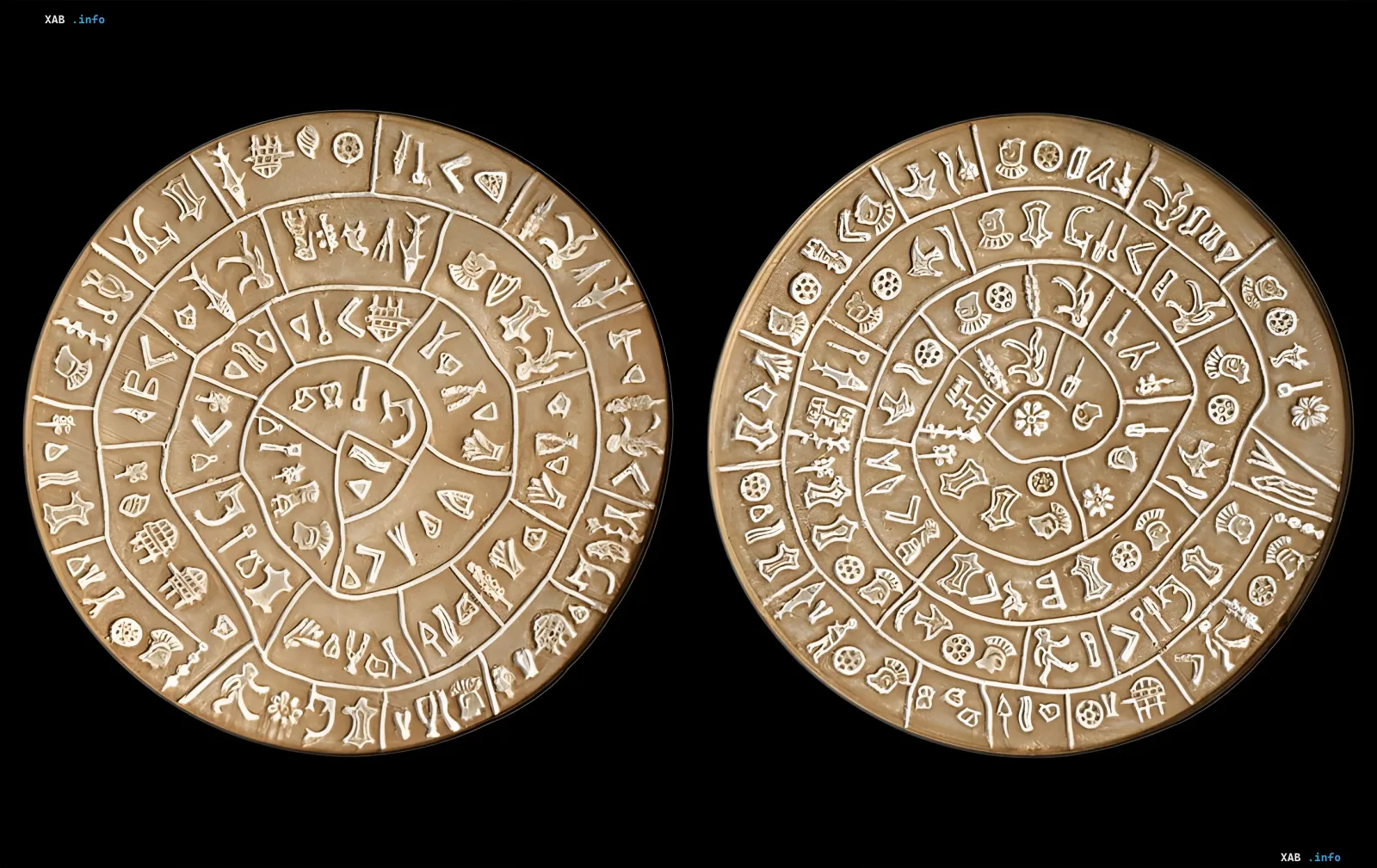
The Phaistos Disc, discovered on Crete in 1908, has remained one of the most enduring puzzles in world archaeology for over a century: it is the only known carrier of an undeciphered sign sequence that fits into no known writing system. A new study, published on the ResearchGate platform and reported by RBC-Ukraine, proposes a radical turn: abandon the attempt to read the disc as an ordinary alphabet or syllabic script and instead treat it as a ritual object whose logic of creation is fundamentally different from that of the administrative tablets of Linear A, found in the palaces of Minoan civilization.
Why the disc does not behave like “text”
The authors' key argument is the absence of an archival context. The disc was not found in an archive or a scribe's working room, but in a lower semi-basement chamber where, by archaeological convention, cult objects were stored. This immediately casts doubt on the idea that we are dealing with an accounting or clerical record. The unique technique of execution adds weight: all 45 types of symbols were not scratched with a stylus but stamped into wet clay using special seals. This method ensured the clarity and stability of the signs rather than the speed of writing, which is characteristic not of everyday writing but of reproducing a canonical, “correct” image.
The spiral as an instruction for ritual
The inscription on the disc unfolds in a spiral from the edge to the center, and, according to the researchers, this is not random layout but a functional solution: it forces physical interaction with the object — turning it in one's hands and slowly following the movement of the symbols. Under the new interpretation, the signs themselves (people, plants, weapons, birds) served as mnemonic cues: they did not convey the sounds of speech but indicated the sequence of actions, the roles of participants, or the refrains during sacred chants. The spiral form, the authors note, traces back to serpent symbolism, which was central to the chthonic cults of Minoan Crete, and the entire disc resembles a portable labyrinth in which movement from the periphery to the center symbolizes immersion in the ritual and transformation.
The authenticity of the artifact
It is precisely because of the lack of analogues that a significant portion of scholars considered the disc a twentieth-century hoax for decades. However, according to the new analysis, the artifact is confirmed as genuine: the clay composition fully matches local Cretan sources, and the firing technology is characteristic of the Bronze Age. Moreover, creating dozens of detailed seals for the sake of a forgery, with no clear benefit and no comprehensible text, makes no practical sense. The disc also fits into the Minoan tradition of “decommissioning”: ritual objects, after their role was complete, were often buried, interred, or left in closed sanctuaries, which explains the very context of the find.
Contradictory data
Two polar positions have historically coexisted around the artifact. On the one hand, some researchers and publicists (including in earlier publications, for example, in 2008 materials) insisted that the Phaistos Disc was an ordinary forgery created in the modern era. On the other hand, the new study on ResearchGate and the accompanying archaeological analysis point to its authenticity: the clay's match with local strata, the Bronze Age firing characteristics, and the illogic of making dozens of seals for a fake. The disagreement comes down less to the physical composition of the object than to interpretation: is it a genuine ritual object of the Minoan era or a later imitation. Until independent verification of the new study's conclusions becomes widely accepted, both versions remain in the field of scientific discussion.
The authors' practical conclusion is that after the decline of Minoan civilization and the loss of the ritual practice, the disc simply lost its meaning, becoming an artifact of the past. This is precisely why the attempt to “read” it as a language that may never have existed in the conventional sense may be a dead end: before us is not a text to be read but a tool for action, whose meaning was tied to a living ritual tradition rather than to the transmission of information between generations of scribes.