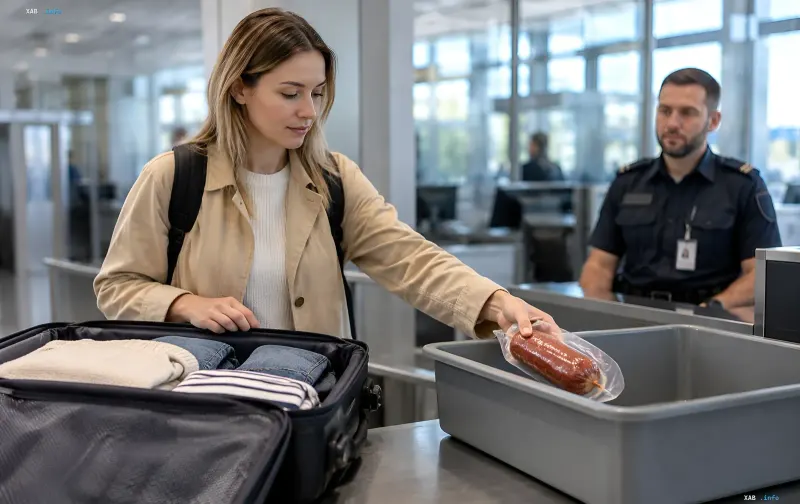
Before traveling to Poland, Ukrainian citizens are advised to check the contents of their suitcases and carry-on luggage in advance. According to data cited by RBC-Ukraine from the Ministry of Finance, the National State Administration, the Chief Pharmaceutical Inspectorate, and the Polish Border Guard, certain food products are prohibited from being imported into the European Union even in small quantities, while quantitative limits apply to other items. Failure to comply with these rules may result in the confiscation of goods at the border, so knowing the current regulations helps avoid delays and questions during customs control.
Prohibition on Products of Animal Origin
One of the key restrictions concerns products of animal origin. Meat and meat products — in particular sausages, lard, and pâtés — as well as milk and dairy products cannot be imported from Ukraine into Poland. This restriction applies even to small quantities of food intended for personal consumption. According to the official position, such products may contain pathogens of infectious animal diseases, so they should be left in special containers at the border.
Phytosanitary Requirements for Plant Products
Restrictions also apply to fruits, vegetables, and plants. As a general rule, importing fruits, vegetables, plants, seedlings, and cut flowers requires a phytosanitary certificate confirming that the products are not infected with harmful pests and diseases. Additional restrictions or a full import ban may apply to certain types of plant products. The exception is five types of fruits that can be imported without a phytosanitary certificate: bananas, coconuts, dates, pineapples, and durians.
Exceptions and Quantitative Limits
In addition to general prohibitions, exceptions are provided for certain categories of goods. Up to 20 kg of fish and fish products per person may be imported into the European Union, or a single fish if its weight exceeds this limit; the rule covers fresh, gutted fish, as well as prepared or processed fish products. Up to 2 kg of baby food, dried milk for infants, and special products for medical purposes may be carried, provided they are in factory packaging, do not require refrigeration until opened, and are intended for direct consumption. Separately, up to 2 kg of other specified products of animal origin, in particular honey, may be imported.
Alcohol and Tobacco: Rules Depending on the Mode of Travel
Alcoholic and tobacco products may be imported into Poland within established limits, which apply to travelers aged 17 and over. The limits for alcohol are the same regardless of the mode of travel, and it is permissible to combine spirits and drinks with an alcohol content of up to 22% so that the total share of used limits does not exceed 100% — for example, instead of one liter of spirits, you may import 0.5 liter of such a drink and 1 liter of alcohol with a strength of up to 22%. Quiet wine and beer are not included in this proportion and are additionally permitted in the established quantities. The difference depending on the mode of travel concerns, above all, tobacco products, where a proportional limit rule applies: you may import the full allowance of one type of product or combine several types so that their combined share does not exceed 100% of the permitted volume. For passengers on aircraft and sea vessels, the limit is five times higher and amounts to 200 cigarettes, 100 cigarillos, 50 cigars, or 250 grams of tobacco; when crossing the border by land, the corresponding lower values apply. Separate excise-duty-free quantitative limits are established for e-cigarette liquids, novel tobacco products, and other nicotine products.
Medicines: What Can Be Imported Without Special Permits
Ordinary medicines for personal use, not containing narcotic or psychotropic components, may be imported into Poland without special permits in a quantity of up to five smallest packages per item. To avoid questions during customs control, the medication should be carried in its original packaging, and a prescription or an excerpt from the medical record confirming the need for treatment should be kept on hand. At the same time, it is important to check the composition of the medications in advance: certain sedatives, sleep aids, or painkillers that are sold in Ukraine with an ordinary prescription may be classified in Poland as narcotic or psychotropic substances, the transport of which is subject to strict rules. Before the trip, it is necessary to obtain the corresponding document from the Chief Pharmaceutical Inspectorate of Poland (GIF), which is issued for a specific medication and a defined treatment period and is valid for no more than 30 days.