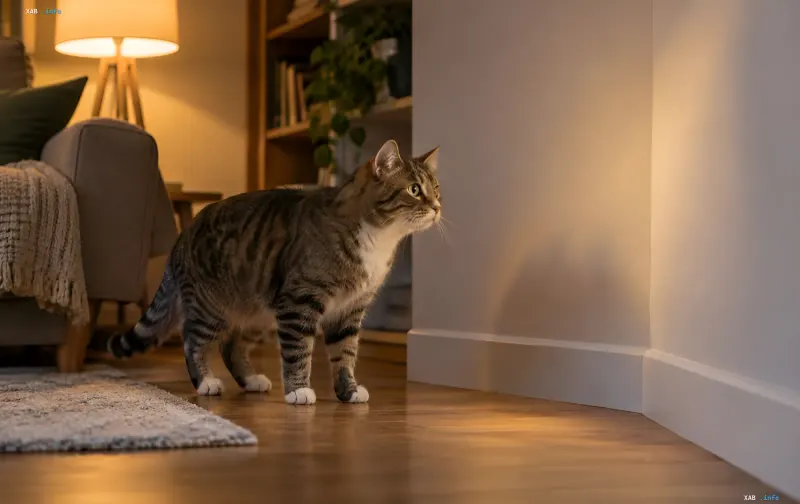
Every cat owner has noticed their pet suddenly freezing in the middle of a room, staring intently at a wall, ceiling, or what appears to be an empty corner for seconds or even minutes. To a human, there is no movement, sound, or shadow in that space. However, for the animal, the wall may not be “empty” at all. In various cultures, this behavior has long been surrounded by mystical interpretations, whereas modern zoopsychology and veterinary medicine offer concrete explanations rooted in the peculiarities of feline hearing, vision, and predatory instincts.
Folklore: the cat as a “seer of the unseen”
In the study of folk beliefs, The Wild World of Cat Beliefs, cats were often linked to the spirit world and supernatural entities. Hence the common notion: if a cat freezes and stares into a corner, it is supposedly seeing something inaccessible to human perception. In Persian folk traditions, for example, a cat licking its paws by the door heralded the arrival of guests. In other cultures, a cat frozen at an entrance was viewed as a harbinger of news or impending events. Superstitious explanations often interpret this fixed gaze as a “premonition,” though there is no scientific evidence that animals can predict the future in this way.
What cats actually see and hear
Veterinarian Dr. Louise Barnes points out that cats can see, hear, or sense things humans simply miss. A study published in 1985 in the journal Hearing Research showed that domestic cats can perceive frequencies from 48 Hz to 85 kHz—a range far exceeding human hearing. This means that an animal sitting in front of a wall may not be “staring” at nothing, but listening intently: a faint sound inside the wall, movement in pipes, neighbors' footsteps, or the rustle of small rodents behind the partition remain inaudible to humans but are perfectly clear to a cat. Beyond hearing, vision and hunting instincts are at play: a tiny insect, a dust mote in a beam of light, a faint shadow, or a reflection can capture a cat's attention for a long time.
When staring into space is normal versus when to be concerned
If your cat occasionally freezes and stares at a spot but remains active, eats well, plays, and responds to you, there is no cause for alarm. As experts note, not every “mysterious gaze” carries hidden meaning—it is often just focus on a stimulus or plain feline curiosity. However, the situation changes if this behavior appears suddenly, becomes frequent, and is accompanied by disorientation, changes in appetite, sleep disturbances, or other unusual symptoms.
Staring at walls as a potential marker of cognitive decline
Cornell University highlights that prolonged, aimless staring into space or at walls can be a manifestation of cognitive dysfunction in senior cats. This does not mean every such case indicates a disease, but consistent changes in behavior in older cats should be discussed with a veterinarian. Thus, behind a cat’s “mystical” gaze in the vast majority of cases lies sharp hearing, attentive vision, and an innate hunting reflex—not contact with the supernatural.