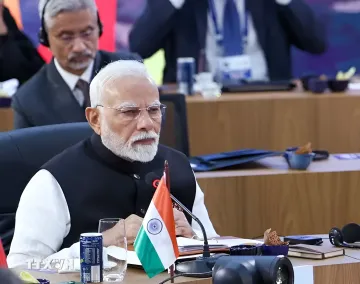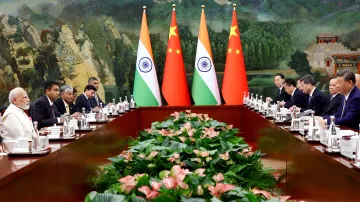
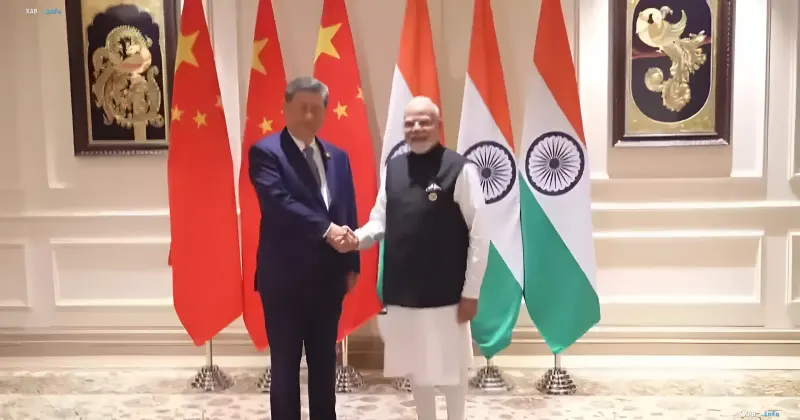
On September 12, 2026, on the sidelines of the BRICS summit in New Delhi, the leaders of China and India — Xi Jinping and Narendra Modi — held a meeting. According to the Indian Ministry of External Affairs, this is the first visit by the President of the PRC to India in seven years. Against the backdrop of the two nations' flags — the red flag with yellow stars and the tricolor with the Ashoka Chakra — the heads of state exchanged handshakes and discussed key areas of bilateral cooperation.
First Meeting in Seven Years
The statement by India's Ministry of External Affairs emphasized that both leaders agreed on the need to further develop cultural exchange, business ties, and increase the number of visits between the two countries. As reported by Xinhua News Agency, Xi Jinping stated that China has always viewed and developed its relations with India in a strategic and long-term manner: exchanges between the relevant departments are gradually being restored, areas of cooperation are expanding, and bilateral trade has reached new heights.
Economy and Trade Imbalance
In the economic part of the talks, the parties agreed on the need to address each other's concerns, including structural trade imbalances and supply chain disruptions, as well as on simplifying access for the two countries' businesses to each other's markets. According to Chinese customs data, the projected bilateral trade volume in 2025 will reach a record $155.6 billion. China remains India's largest source of imports: in the 2025–2026 fiscal year, New Delhi expects to import Chinese goods worth approximately $132 billion, with significantly lower exports, resulting in a trade deficit of over $100 billion.
Historical Context and Border Issues
The relations between the two countries are non-linear: after the brief border war of 1962, they deteriorated again following the 2020 clash, in which 20 Indian and 4 Chinese soldiers were killed. A warmer turn began in late 2024, when the leaders agreed to end the military standoff in the western Himalayas. In India's statement, Modi emphasized that peace in the border areas is a vital foundation for developing relations; the two countries' shared border is approximately 3,800 km long.
Contradictory Data
The publications feature two different sets of figures that, on a superficial reading, may appear inconsistent: the total trade volume of $155.6 billion is attributed to the calendar year 2025, while the import figure of $132 billion and the deficit of over $100 billion refer to the 2025–2026 fiscal year. This is not a contradiction but a difference in accounting periods (calendar year vs. fiscal year) and in metrics (total turnover vs. one-way imports); however, when citing these figures, it is important not to mix them up, in order not to distort the scale of the trade imbalance.
Reaction and Next Steps
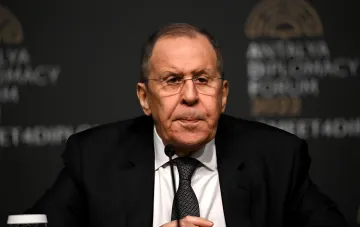
The meeting took place within the framework of the expanded BRICS format, where, according to reports, the leaders of China, India, and Russia also exchanged a brief "on-the-spot" conversation. The parties recorded their intention to strengthen partnership and maintain peace in the region, which lays the groundwork for practical work over the coming months to remove trade barriers and restore regular inter-departmental contacts.