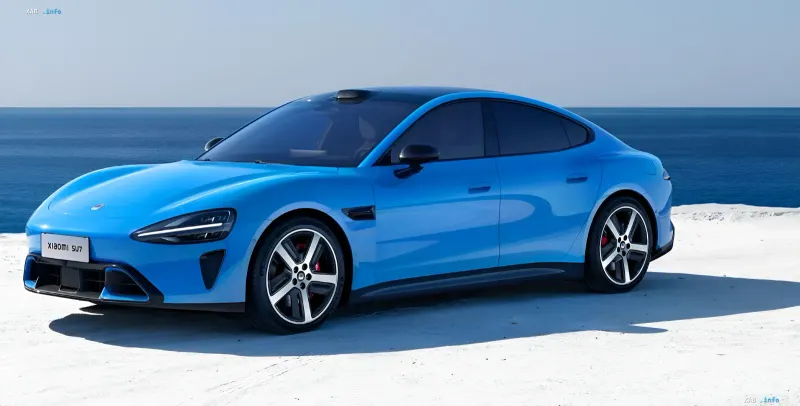
An owner of the Xiaomi SU7 electric vehicle, operating the car under extremely intense workloads, has published a detailed report on the vehicle's condition after 400,000 kilometers of mileage. Over two years of operation, the car has retained 91.08% of its battery capacity, with the current driving range on a single charge remaining at around 500 kilometers. Data on battery degradation was obtained through Xiaomi's official service department after the owner granted appropriate diagnostic permission, giving the figures extra weight: this is not a driver's subjective assessment, but the result of instrumental control by the manufacturer.
Average Consumption and Daily Mileage: Figures Hard to Reproduce in City Driving
The Xiaomi SU7 onboard computer recorded a total energy consumption of 63,455 kWh over the entire operational period. Average consumption was 15.6 kWh per 100 kilometers—a figure quite expected for a coupé-sedan with an aerodynamic profile and a weight of around 2 tons. Meanwhile, the car's average daily mileage was about 548 kilometers, indicating a commercial-grade operation mode: the car is virtually never idle and daily covers a distance comparable to an intercity trip.
Ownership Economics: Clean Charging Costs
Over two years and 400,000 kilometers, electricity costs amounted to about 50,000 yuan. It is important to emphasize that this refers strictly to charging costs rather than the total cost of ownership, which includes maintenance, insurance, depreciation, and consumables replacement. Nevertheless, even in pure form, the figure demonstrates that at such mileage, electricity remains orders of magnitude cheaper than gasoline: for a gasoline-powered car, a similar mileage would require millions spent on fuel.
What Wore Out Faster Than the Battery
Intensive operation with high daily mileage primarily affected the tires: over two years, the owner had to replace nearly four sets of tires. This is a logical consequence of continuous driving at high speeds and under conditions likely involving highway routes. By comparison, in typical urban driving, a single set of EV tires usually lasts 50,000 to 70,000 kilometers, whereas here the resource was consumed three times faster. Meanwhile, the battery demonstrated resilience: losing less than 9% capacity over 400,000 kilometers is a result many EV experts consider exceptional, especially given the extreme load regime.
The Goal: 600,000 Kilometers
The Xiaomi SU7 owner does not intend to stop here and has announced his intention to become the world's first owner of the model to cross the 600,000-kilometer mark. If the goal is achieved, it will serve as a public long-term test not only for the battery, but also for the suspension, braking system, electric motors, and overall body structure under real-world rather than laboratory conditions. For Xiaomi, which is just mastering the automotive market, such stories are a vital element in building trust in product durability.