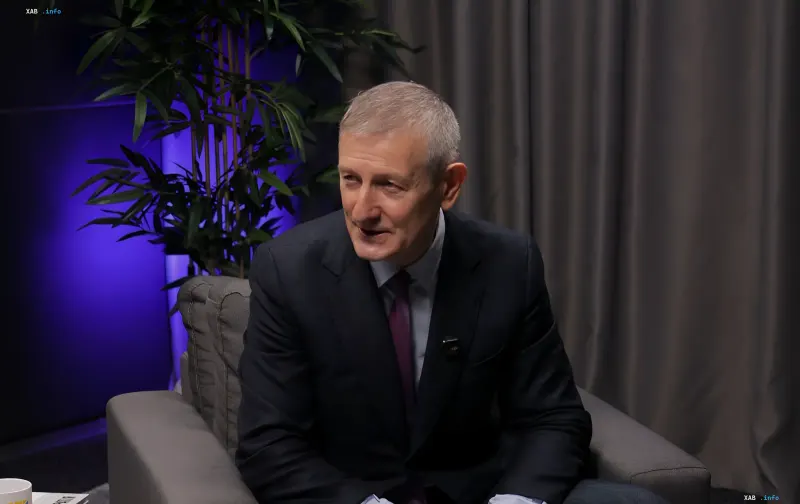
Belarusian economist and President of the International Institute of Freedom Yaroslav Romanchuk, in an interview with RBC-Ukraine's project "Do Not Interrupt!" hosted by Volodymyr Kurennyi, analyzed the state of Ukraine's economy, proposed a radical tax reform, and outlined three possible paths for the country's development after the war ends. According to him, Ukraine will face a choice: to transform into a "Dnipro Tiger" following the example of Ireland and Taiwan, or to slip into inertial decline under the rule of the oligarchy with a population of 25–27 million people. The realization of the optimistic scenario, in the economist's estimation, is possible only under conditions of complete economic, monetary, and financial freedom.
Economy of Endurance: Who Will "Die" First
Romanchuk acknowledges that formally the resources of the Russian economy are more powerful: he estimates its GDP at approximately 2.7–2.8 trillion dollars compared to 225–230 billion dollars for Ukraine, which is almost ten times more. Russia's exports in 2026, he says, could amount to about 470 billion dollars, providing foreign exchange earnings and the ability to finance the war. If one compares only these indicators, one might conclude that the Ukrainian economy will be the first to face crisis. However, in the economist's view, Ukraine's strength lies not only in its own economy: the country relies on the resources of the European Union and partners, and the European economy as a whole amounts to about 22 trillion dollars. Strengthening the European security system and more active involvement of EU and NATO countries, he says, will significantly increase Ukraine's capabilities.
Tax Reform: A Single Tax Instead of a "Patchwork Quilt"
Speaking about the causes of stagflation, Romanchuk emphasizes that inflation is a monetary phenomenon, and before looking for a cure, a diagnosis must be made. He notes that over 30 years, average annual inflation in Ukraine was nearly 13%, and in 2026, by his estimate, it will be at the level of 12.5%. Instead of a large number of taxes, the economist proposes introducing a single tax on retail turnover with a rate of 12–13%, abolishing VAT, payroll tax, and corporate profit tax, as well as reducing regulatory pressure.
Real Exchange Rate of the Hryvnia and Multi-Currency System
According to Romanchuk, without international grants and partner assistance, the balanced exchange rate of the dollar should be at least 75–80 hryvnias. At the same time, he emphasizes that the exact rate under conditions of complete liberalization is impossible to predict, and proposes introducing a multi-currency system as a tool to reduce currency risks.
Three Scenarios: From Decline to the "Dnipro Tiger"
The economist highlights three post-war scenarios: the path of economic decline, the path of slow growth, and the path of the "Dnipro Tiger." The latter provides for economic, monetary, and financial freedom, deregulation, and the development of private business. It is this scenario, he says, that allows a country with a population of 25–27 million people to surpass in economic development countries with significantly larger populations.
Political Risks and the European Security System
Answering a question about the risks associated with the potential victory of Marine Le Pen in France, Romanchuk cites the example of Giorgia Meloni in Italy: despite belonging to the right-wing spectrum and concerns about her position, Italy became one of Ukraine's best allies in the EU and NATO. He notes that even if individual countries change course, Denmark, the Netherlands, Germany, the Baltic states, Sweden, Finland, and Norway can act more actively, and the European part of NATO can be reformatted into a defense alliance of 10–15 countries. Ukraine, he says, should not simply ask to join the European security system, but should be its co-founder. The goal, according to the economist, is not only to return to the 1991 borders, but also to ensure peace in Europe.