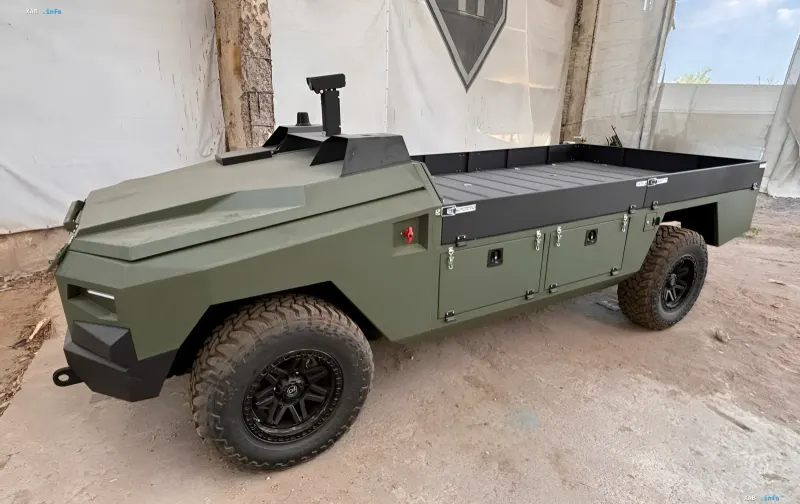
Ukraine has officially set its course on large-scale robotization of the front, and the pace of industrialization of ground robotic complexes (GRCs) has accelerated sharply over the past year. However, according to testimony from one of the key players in the personnel training market, this strategy contains a critical systemic failure: none of the seven private schools certified by the Ministry of Defense has received a single hryvnia of state compensation for operator training over twelve months. This was explained in a column for RBC-Ukraine by Viktor Pavlov, founder of the GRC School and an officer of the GRC battalion of the 3rd Separate Mechanized Brigade of the Third Army Corps. In his words, the payment mechanism set out in the government resolution has simply not worked due to a bureaucratic deadlock between the relevant agencies.
The Course on Robotization: Goals and Figures
In April, President Volodymyr Zelenskyy instructed the Ministry of Defense and the General Staff to ensure the delivery of no fewer than 50,000 ground robotic complexes to the Armed Forces in the current year. According to the Ministry of Defense, since the beginning of 2026 the state has already contracted for more than 22,000 GRCs — nearly twice as many as for the entire year of 2025. An industry that, just a few years ago, effectively did not exist is transforming into a mass component of infantry armament. But, as the column's author emphasizes, a robot without a trained operator and without an engineer capable of configuring the complex for a mission or restoring it after being shelled is simply iron sitting in a warehouse. If the pace of equipment production outpaces the pace of personnel training, the main brake on robotization will not be a shortage of platforms but a shortage of qualified personnel: thousands of operators and engineers are needed to complete the existing units and deploy new ones.
How the Voucher Mechanism Is Supposed to Work
As early as autumn 2024, the government launched an experimental project on the certification of private drone schools and the payment for operator training services (Resolution No. 1129). At the end of August 2025, the Cabinet of Ministers adopted amendments to this document (Resolution No. 1047), extending the certification and financing procedure to ground robotic and aquatic complexes. The state declared a market model: private schools undergo an audit, receive certification from the Ministry of Defense, and their work is financed through a system of state vouchers — the money was supposed to follow "the soldier." As described in Resolution No. 1129, the state customer publishes a request for prices, schools submit their calculations, a state contract is concluded, vouchers are issued under it, a military member chooses a school and trains, and the school receives payment after the fact — after the exam and certification. On November 19, 2025, the Ministry of Defense already reported on the certification of the first seven private GRC schools.
Where the Financial Chain Got Stuck
The problem is that to launch the mechanism — announcing the request for price proposals and issuing vouchers — an officially formed and approved operational requirement from the General Staff is needed: the military leadership must clearly define how many operators of specific types of logistical, engineering, or combat robots need to be trained. Without this financial order, it is legally impossible to launch. The wording in the resolution that operator training services are procured "subject to the availability of the corresponding budget appropriations" has turned into a closed loop: funds are not allocated because, legally, the state order for training has still not been formed. As a result, according to Pavlov, state examiners come to the schools, conduct the exams and sign recommendations for graduates to be assigned military accounting specialties, but the voucher payments themselves exist only on paper — "just as in the aerial component of drones."
Contradictory Data
Here there is a notable gap between the official statements of the agency and the actual state of affairs. In an official release dated November 19, 2025, the Ministry of Defense asserted that by the end of 2025 the state would pay for the training of thousands of military members in certified schools, which would allow scaling the use of GRCs on the battlefield. However, according to testimony from the schools' own representatives, by autumn 2026 — twelve months after the adoption of the reform and long after the "end of the year" had passed — none of the seven schools had received a single hryvnia, and the government financing program "has not just stalled, it has not even moved off the line." Thus, the Ministry of Defense's public commitment to pay compensation during 2025 does not match what the certified schools report about the actual absence of payments; there is no independent confirmation or refutation of this assessment in the provided sources, and both versions — the declared readiness of the state to finance training and the zero payments recorded by the schools — remain in contradiction with each other.
What This Means for the Front
While the state mechanism is stalled, the schools, according to their founders, continue to operate in a mode not supported by the promised financing. The strategic risk is obvious: if the bureaucratic chain is not launched, mass production of GRCs will hit a personnel ceiling, and the technological advantage that Kyiv is trying to secure for the infantry will be limited not by the number of platforms but by the state's ability to quickly and with payment train the people who operate and repair these platforms. Resolving the deadlock, as follows from the described logic, lies not in the schools but in the General Staff and the Cabinet of Ministers — in forming the official order and allocating appropriations, without which the voucher model remains a declaration.