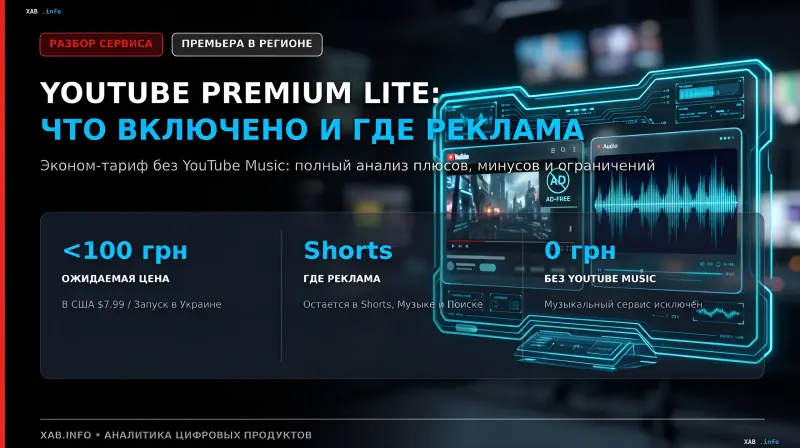
In parallel with the revision of pricing for its basic plans, Google is expanding the geographic reach of the budget-tier YouTube Premium Lite to all markets where the classic subscription is available, including Ukraine. In the US, the Lite plan costs $7.99 per month, while on the Ukrainian market a price of up to 100 hryvnia is expected, positioning the tier as a functional replacement for the former individual plan. This decision fits into a broader trend of segmenting subscription products, in which digital platform operators divide their audience by depth of content consumption.
Macroeconomic context: rising prices for basic tiers
The launch of the Lite tier comes against the backdrop of a significant increase in the cost of standard YouTube Premium in Ukraine — up to 179 hryvnia per month, which, according to estimates by specialized publications, brought the growth close to doubling relative to the previous level. In conditions of inflationary pressure and declining purchasing power, such tariff differentiation serves as a price anchor: the platform retains its core audience by offering a reduced but noticeably cheaper package, rather than losing users for whom the full set of features is excessive.
Tier structure and the legal framework of the subscription
From the standpoint of consumer rights, the key point is the precise delineation of features. Premium Lite fully disables ads in long-form videos, but retains ad integrations in the Shorts feed, in search results, and on the homepage. The package does not include YouTube Music Premium — the user receives only the free, ad-supported version of the music service. Background playback and offline video downloads are available in a limited mode, unlike the full access in the standard tier, which supports downloads up to 1080p and 4K resolution. These restrictions are legally fixed in the subscription terms and determine exactly which set of rights the subscriber acquires.
Geographic expansion and pricing policy
According to industry sources, the Lite plan is becoming available in all regions where the classic Premium is present, which means the unification of the product line at a global level. For Ukraine, this means the emergence of a formal budget segment aimed at viewers of talk shows, lectures, reviews, and podcasts on PC and Smart TV, who simultaneously use third-party streaming services and do not need the YouTube Music catalog. A price corridor of up to 100 hryvnia makes the tier competitive against alternative paid subscriptions.
Contradictory data
The available sources record inconsistencies that require separate presentation. First, the exact cost of Lite in hryvnia has not been officially fixed: the materials use the phrasing "expected up to 100 hryvnia," while the standard tier is already confirmed at 179 hryvnia. Second, some sources point to a sequential expansion of the Lite tier's features, which may contradict the static description of background and offline capabilities as "limited." Thus, the actual set of features and the final price in Ukraine at the time of publication may differ from the stated benchmarks.
Long-term consequences for the market
In the medium term, tariff segmentation intensifies competition between platforms for the "average" user and increases the importance of price transparency. For the Ukrainian advertising market, a dual effect persists: ad blocks in Shorts and search remain monetizable even for Lite subscribers, partially offsetting the loss of revenue from ad removal in long-form videos. For regulators and consumers, the key factor becomes the quality of disclosure of the tier's limitations, since it is precisely the delineation of features that shapes the real value of a budget subscription.