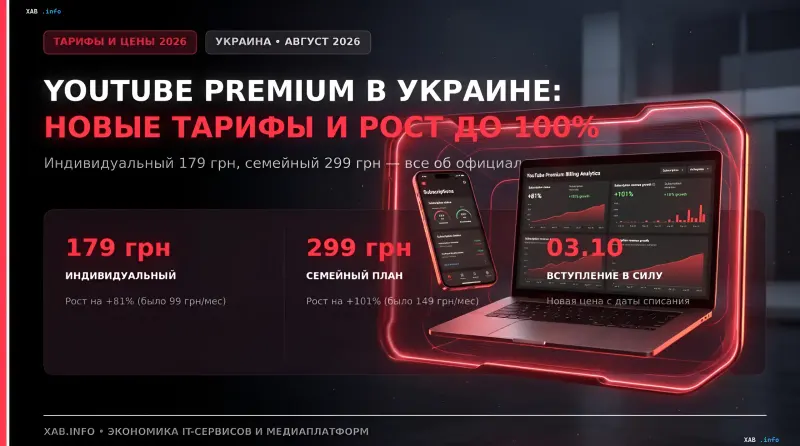
Google has initiated a mass mailing of notifications to Ukrainian users of the YouTube Premium service, recording a substantial revision of its pricing policy across all active tariff plans. According to specialized publications RBC-Ukraine and Ukrainskie Novosti, the adjustment is systemic in nature and affects the individual, family, and student segments. For new users, the updated rates apply immediately, while for existing subscribers the cost change is tied to the next billing period — for most subscribers this is October 3, 2026. Thus, the company is implementing a smooth transition model, preserving a preferential 30-day period for the current user base until the first charge at the updated price.
Scale of the Price Adjustment
The quantitative assessment of the changes shows a non-uniform but overall high dynamic. The individual tariff has been increased from 99 to 179 UAH per month, corresponding to an 80.8% rise. The family subscription, designed for up to five members, has become more expensive from 149 to 299 UAH per month — effectively a doubling (+100.7%). The student plan has been revised from 59 to 109 UAH per month (+84.7%). The most pronounced adjustment has been recorded precisely in the family segment, indicating a deliberate change in the margin of mass household consumption of ad-free content.
Macroeconomic Context and Inflationary Dynamics
As noted by Delo.ua, the price revision in the region is driven by a global inflationary adjustment of digital services. In conditions of sustained growth in infrastructure costs, content licensing, and platform localization, operators of the digital economy pass on part of the inflationary pressure to the end user. For the Ukrainian market, this means that the tariff for premium video content is now indexed taking into account regional purchasing power, not only global rates, which forms a new price benchmark for adjacent streaming services.
Legal and Procedural Details of Billing
From the standpoint of consumer procedures, the key element is the tying of the change to the billing cycle. Existing subscribers are not subject to retrospective recalculation: the preferential 30-day period until the first charge at the new price effectively secures the right to retain the previous price until the end of the current paid cycle. New users, who subscribe after the notification mailing, are immediately fixed at the updated rates. Such a structure minimizes legal risks on the part of the operator and ensures transparency of the transition period.
Strategic Context: Launch of the Premium Lite Tariff
In parallel with raising the base rates, Google is preparing the infrastructure for the launch of a more affordable YouTube Premium Lite tariff. This indicates segmentation of the product line: the premium segment becomes more expensive, while the budget option is intended to retain the mass audience and reduce churn. In the medium term, such a bifurcation of tariffs may change the service's revenue structure and redistribute users across price levels, which is a typical practice for digital platforms under inflationary pressure.
Contradictory Data
In open sources, there is a discrepancy in the completeness of the description of the changes. The main notifications and some publications (including Slobidne Dilo, itc.ua, ukraina.ru) focus exclusively on the price increase across the three tariffs. At the same time, the publication ukranews.com additionally points to the introduction of new restrictions for family subscriptions, the details of which are not disclosed in the primary notifications under consideration. Thus, the version limited to a price revision and the version including a change to the family tariff terms are not identical. Until the official terms of the family plan are published, it is recommended to treat information about the restrictions as additional and requiring confirmation.
Long-Term Consequences for the Market
In the long term, the doubling of the family tariff may stimulate growing demand for the budget Premium Lite segment and simultaneously increase the sensitivity of the Ukrainian consumer to the price of digital subscriptions. For competitors in the streaming market, this sets a new price ceiling and simultaneously signals that the inflationary adjustment has become the norm for premium content. For the regulator and consumer organizations, the key issue remains the transparency of transition terms and the compliance of the changes with current requirements for informing subscribers about changes to tariff conditions.