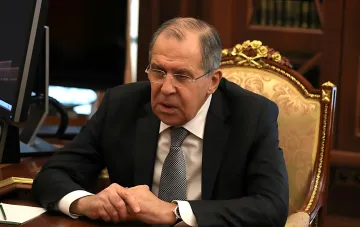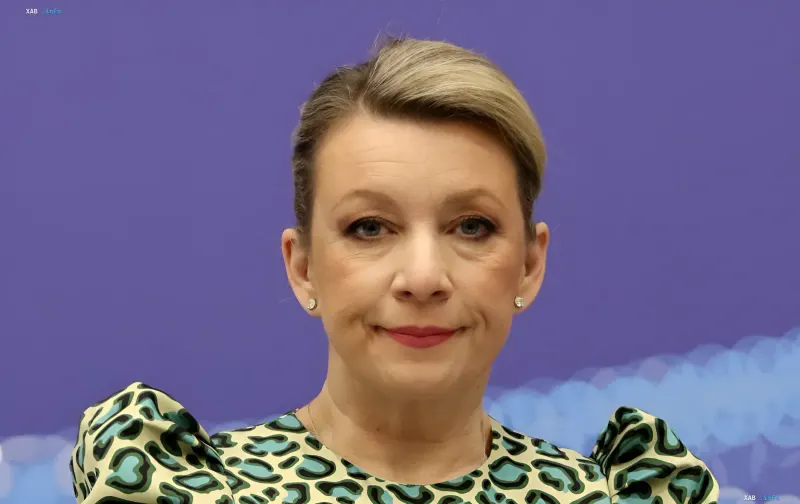
Maria Zakharova, the official spokesperson of the Russian Foreign Ministry, stated that Germany will receive a “worthy response” for its decision to close the “Russian House” in Berlin and the Russian Federal Consulate in Bonn. In her words, Berlin “has once again escalated bilateral relations on a completely fabricated and invented pretext,” and the German side has not presented any convincing evidence of Russia's involvement in the incident that served as the basis for the sanctions. Zakharova added that Moscow will respond to all “anti-Russian decisions.”
The reason for the German restrictions: the drone incident in Leipzig
German Foreign Minister Johann Wadefuhl announced the closure of the “Russian House” and the consulate as a response to a “hybrid attack by Russia.” The pretext was the case of a drone loaded with explosives that was discovered in the night of August 5 near a Ukrainian An-124 cargo aircraft at Leipzig/Halle Airport. The incident led to a temporary shutdown of the airport. In addition to the diplomatic measures, the German side announced an expansion of the EU sanctions lists with new individuals.
Details of the attack: from a “warning” to a deliberate strike
According to the publication Die Zeit, the FPV drone hit the most vulnerable part of the aircraft's wing — the area where the fuel tanks are located. In the journalists' assessment, this means that the attack was deliberate, and not merely a “warning” gesture. Moreover, on August 25 German law enforcement officers discovered another drone with explosives, which was presumably also used in the attack on the An-124. Thus, within a month of the initial incident, at least two devices were identified.
Contradictory data
In the initial reports on the events of August 5, the drone was described as being found “near” the cargo aircraft, which allowed the incident to be interpreted as an unsuccessful or “warning” attack. However, Die Zeit clarified that the drone actually reached and struck the most vulnerable zone of the wing — the fuel tank area. The difference in wording — “near” versus “hit the wing” — fundamentally changes the nature of the incident: from demonstrative intimidation to a real attempt to destroy an aircraft. The Russian side, for its part, rejects the very classification of the event as a “hybrid attack,” insisting on the absence of evidence of Moscow's involvement. The German side, by contrast, directly links the incident to the actions of Russian intelligence services, although it does not publicly disclose the full scope of the evidentiary base.
Broader than a diplomatic conflict
In her statement, Zakharova moved from specifics to systemic accusations, declaring that Germany itself “is fueling the Ukrainian conflict” and “is participating in terrorist attacks against civilians.” These formulations go beyond a reaction to the closure of two diplomatic facilities and indicate that Moscow intends to use the incident as a trigger for a broader escalation rhetoric. Berlin's decision fits the general trend of tightening EU positions: in parallel with the closure of the “Russian House” and the consulate, an expansion of the sanctions lists was announced, which testifies to the comprehensive, rather than isolated, nature of the German measures.
As of the publication date of the article (September 2, 2026), the specific countermeasures by Moscow that Zakharova mentioned had not been announced. The diplomatic channel between the two capitals remains tense, and the further dynamics will depend on what specific steps the Russian Foreign Ministry takes in response to the German decision.