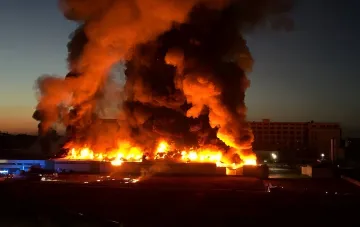
On the night preceding September 7, the Russian armed forces struck Zaporizhzhia using unmanned aerial vehicles (UAVs). A city shopping mall was hit by the attack and a fire broke out. This was reported by Ivan Fedorov, head of the Zaporizhzhia Regional Military Administration, according to RBC-Ukraine, who added that the incident "passed without casualties." In his words, the enemy attacked the city with drones, as a result of which the shopping mall caught fire, but no victims were recorded among residents or staff.
Chronology of the night strike
Immediately upon the arrival of the new day, a yellow threat level — so-called "drone" mode, introduced when the risk of drone use is elevated — was declared in Zaporizhzhia and the region. After that, according to regional authorities, a strike was carried out against the city, resulting in a fire at the shopping mall. Ivan Fedorov subsequently published footage of the aftermath of the shelling, recording the fire and damage to the facility. The official OVA version emphasizes the absence of casualties, which distinguishes this attack from a number of preceding strikes on the city during the same week.
State of infrastructure and damage assessment
The main object affected during the night attack was the shopping mall, which became the source of the fire. Preliminary data indicates that the fire damaged the facility's premises; however, according to the OVA head's statement, no people were injured. The publication of aftermath footage by regional authorities allows an assessment of the scale of the fire and the nature of the damage, although a detailed list of destruction and the amount of damage had not been officially disclosed at the time of preparing this material. A repeated hit on a commercial object indicates the vulnerability of the city's civilian infrastructure to aerial strikes.
Series of strikes on Zaporizhzhia over the week
The night attack was not the only one in recent days. On the evening of September 5, the Russians also attacked Zaporizhzhia with drones: residential buildings and an administrative building were damaged, and casualties were recorded among residents. Earlier, on the night of September 4, a Russian army strike on the city led to a fire in one of the high-rise buildings. Thus, over a short period, the Zaporizhzhia region was subjected to a series of attacks combining strikes on residential development, administrative and commercial facilities, forming a consistent picture of pressure on urban infrastructure.
Contradictory data
When comparing reports from different publications, discrepancies arise in the figures for casualties and the nature of the damage, due to the fact that some sources aggregate several strikes from different dates. According to the official assessment by Ivan Fedorov, the night attack on the shopping mall passed without casualties. At the same time, a number of publications in the same information cycle (including materials referring to earlier strikes, for example from July 25, when casualties and a damaged shopping mall were recorded, as well as reports on jet-powered UAVs that damaged residential high-rises in Kyiv and Zaporizhzhia) indicate the presence of victims and significant damage. Both versions reflect events at different times: for the night strike on the shopping mall, the official version of no casualties applies, while data on victims relates to preceding attacks. Until regional authorities clarify the full chronology and final figures, these discrepancies should be regarded as the result of overlapping several incidents in a single information stream.
The situation in Zaporizhzhia remains tense: repeated strikes on the city over the week, including the night attack on the shopping mall, confirm that the region's civilian and commercial infrastructure continues to be under threat. Official bodies promise to report on the consequences as data is clarified.